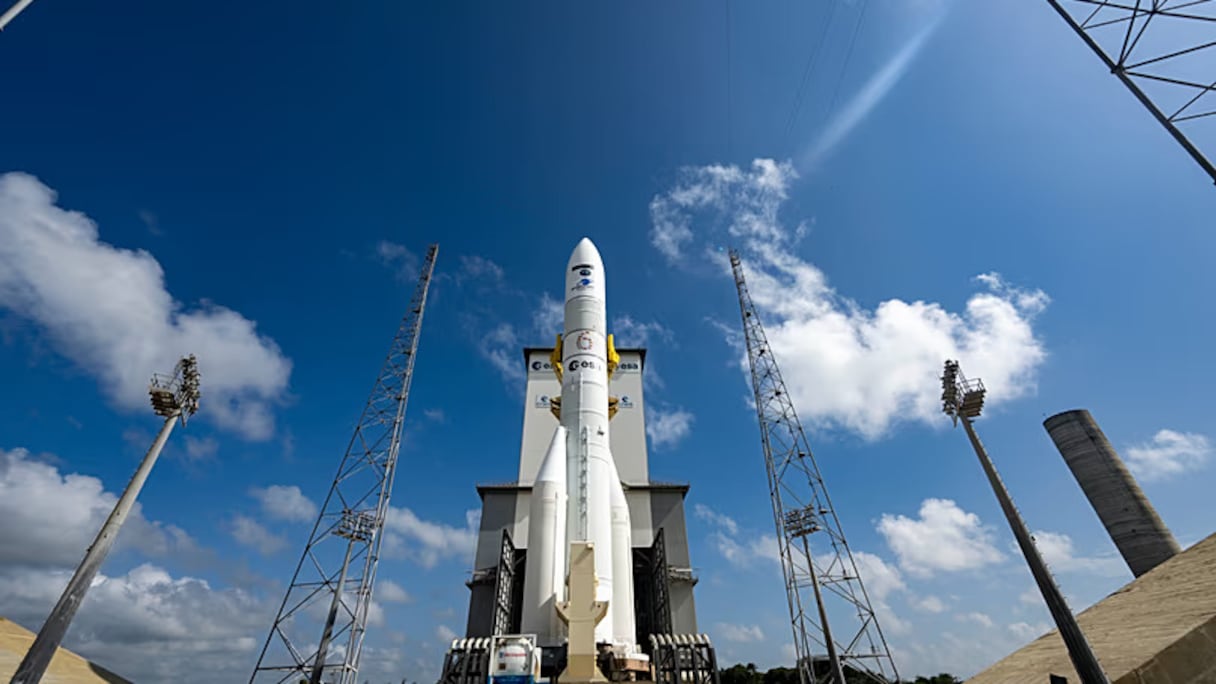
The launch took place at 5:11 p.m. local time from Europe’s Spaceport in Kourou, French Guiana, at the start of a 2.5-hour launch window. Ariane 6 deployed the satellite about 36 minutes after liftoff.
Built to carry a range of payloads into different orbits, Ariane 6 is Europe’s latest heavy-lift launch vehicle. It comes in two configurations: Ariane 62, equipped with two solid-fuel boosters, and the more powerful Ariane 64, which uses four.
The rocket launched Thursday in its two-booster configuration, carrying the 3,800-kilogram MTG-I2 satellite for the European Organisation for the Exploitation of Meteorological Satellites (EUMETSAT).
MTG-I2 is the second imaging satellite in the Meteosat Third Generation program and will join two other spacecraft already in orbit. MTG-I1 was launched in December 2022, while the sounder satellite MTG-S1 was launched in July 2025.
The three-satellite system is designed to provide more detailed observations of Earth, supporting weather forecasting, climate monitoring and the early detection of severe storms.
The satellites can also provide data used to help aircraft avoid storms and improve warnings for flooding, while supporting the monitoring of phenomena such as fires and fog.
Ariane 6 is more than 60 meters tall and can weigh nearly 900 tons when fully loaded. Its central core consists of a liquid-fueled main stage and a reignitable upper stage powered by the Vinci engine, allowing the rocket to deliver payloads to multiple orbits during a single mission.
In its four-booster Ariane 64 configuration, the launcher can carry about 11.5 metric tons to geostationary transfer orbit and up to 21.6 metric tons to low Earth orbit.
Read also : SpaceX reaches 100 Falcon launches in 2026 with 27 more Starlink satellites
The rocket also supports rideshare missions, allowing smaller satellites to be launched alongside larger payloads.
Thursday’s mission was Ariane 6’s ninth flight since its first launch on July 9, 2024. Its previous flight took place in June, when the rocket carried dozens of Amazon broadband satellites into low Earth orbit.
