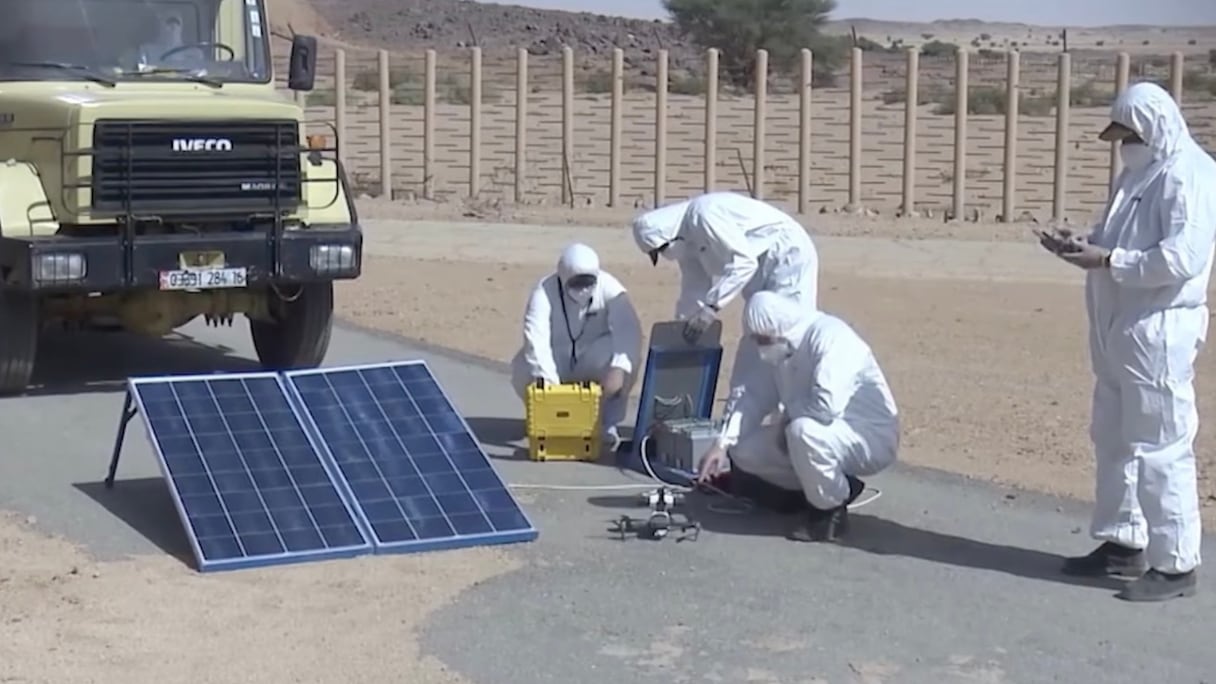
The video, posted by state-owned AL24 News on Algeria’s national holiday, runs for two minutes and 22 seconds. Titled “Launch of the Second Clean-up Operation at the Béryl E2 Tunnel Site,” it is almost entirely silent apart from its soundtrack: music plays over aerial shots of the Taourirt Tan Afella massif, “Danger” signs and a line of technicians in protective suits walking along a fence. A group photograph is taken outside the site’s gate, beneath a banner reading, “Launch of the clean-up campaign at the site of the French Béryl E2 nuclear tests, In Ekker, Tamanrasset, November 1, 2026.”
The only spoken contribution lasts about 40 seconds. Inside a mobile laboratory, a researcher from the Draria Nuclear Research Centre, his face covered by a hood and mask, explains that the operation is being launched “following the completion of all technical preparations,” using a “scientific methodology” and radiation safety procedures that comply with “national and international standards,” drawing on “national expertise.” He provides no measurements, no indication of the area to be treated, no estimate of waste volumes and no timetable.
What the footage actually shows falls well short of what the title promises. Technicians set up solar panels, open instrument cases, consult computers and place a small drone on the ground. These are surveying and mapping tools, not decontamination equipment. The heavy machinery—two cranes, a loader and a tank transporter—remains parked throughout. No soil is removed. Not a single container is filled. At best, the film documents a surveying operation. It passes it off as a clean-up.
The date raises another question. The banner announces a launch on “November 1, 2026,” yet the video, already edited, scored and subtitled, was online by early afternoon that same day. Some shots were filmed under overcast skies, others under clear ones. The “launch” was plainly filmed in advance to coincide with the anniversary of the outbreak of the 1954 revolution. Nor was it the first such launch. Last February, to mark the anniversary of the first nuclear test at Reggane, a Defense Ministry documentary had already presented a “first partial decontamination operation” at the same site, as Algérie360 reported. Nine months later, the banner is announcing yet another launch.
Read also : Nine years on, Algeria is still printing money
Gara Djebilet has been given much the same treatment. On January 31, 2026, in Béchar, President Abdelmadjid Tebboune inaugurated the 950-kilometer railway intended to connect the iron ore mine to Béchar via Tindouf. According to CapDZ, he welcomed the first passenger train from Tindouf and watched a documentary about the project, produced by state television under the supervision of the presidency’s communications department. The official APS news agency also reported that he gave the signal for the first ore convoys to depart. No tonnage figures were released.
On the ground, however, there is still no sign of a working mine. Nine months after the inauguration, not a single figure has been published: no tonnage extracted, no volumes transported, no production data. The only footage captured outside official channels comes from Qatari motorcyclist Khalid Al-Jaber, who passed through the site in early June during a journey that Echorouk News itself had celebrated. His images show a bare open-pit, without a worker or a machine in sight. As for academic Djelloul Slama, whose only offense was to question the deposit’s profitability on television, he was sentenced to four years in prison on October 15.
This is not merely publicity without substance. It is manipulation. At Gara Djebilet, an inaugural convoy is filmed to create the illusion of a working mine. At In Ekker, stationary cranes are filmed to create the illusion of decontamination. In both cases, stagecraft stands in for actual work, and prison awaits those who ask questions.
The AL24 report also conceals the central fact. Of the 17 nuclear tests France conducted in the Sahara—four atmospheric detonations at Reggane and 13 underground tests at In Ekker—11 took place after independence, between March 1963 and February 1966. It was Le Nouvel Observateur that first revealed, in October 1997, in an investigation by Vincent Jauvert, the secret agreements that allowed France to continue nuclear testing in the Sahara after Algeria became independent. Le360 subsequently reported on those revelations.
Read also : Algeria: In yet another tirade, Tebboune displays the full extent of his vulgarity
Independent Algeria thus allowed the tests to continue on its territory for nearly four years. And the cooperation did not end there. According to retired General Rachid Benyellès, quoted by Maghreb Émergent, Houari Boumediene agreed to extend the French presence at the B2-Namous chemical and biological weapons testing facility near Béchar in exchange for an early withdrawal from Mers el-Kébir. The last French personnel did not leave B2-Namous until 1986.
Algiers now demands that Paris hand over maps of contaminated areas and clean up the sites. That demand would carry greater weight if the Algerian state acknowledged its own responsibility: 11 of those tests were conducted with its consent, while Algeria was already sovereign. If the regime is looking for those responsible, it need only consult its own archives. Rather than open them, it releases a video.
At In Ekker, decontamination is a video production. At Gara Djebilet, mining is a photo opportunity. The Algerian regime does not govern. It directs.
