Spread across 1,700 square meters in the city’s historic Mellah, the museum explores a shared Moroccan heritage through seven thematic sections, from the community’s earliest historical traces to contemporary life. Circumcision chairs, framed Jewish marriage contracts known as ketoubas, Torah scrolls, silver jewelry and traditional bridal garments offer a glimpse into the religious, social and cultural life of Moroccan Jewish communities.
For the National Foundation of Museums (FNM), the institution marks a historic first: “For the first time in history, an Arab-Muslim country is allocating public funds to create a museum entirely dedicated to Hebrew culture, an integral part of Moroccan heritage.”
The inauguration drew visitors and officials who described the museum as a message of peace and coexistence.
A museum rooted in the Mellah
The museum stands in Fez’s Mellah, one of Morocco’s oldest organized Jewish quarters, established in 1438. Its architecture draws on the traditional medina, with zellige tilework, carved plaster, painted wood and a marble fountain. The land on which it stands was donated by Fez’s Jewish community.
The project covers 1,700 square meters, including 1,200 square meters of exhibition space. The Agency for the Development and Rehabilitation of the Medina of Fez (ADER-Fès) oversaw the construction, which was completed in March 2023.
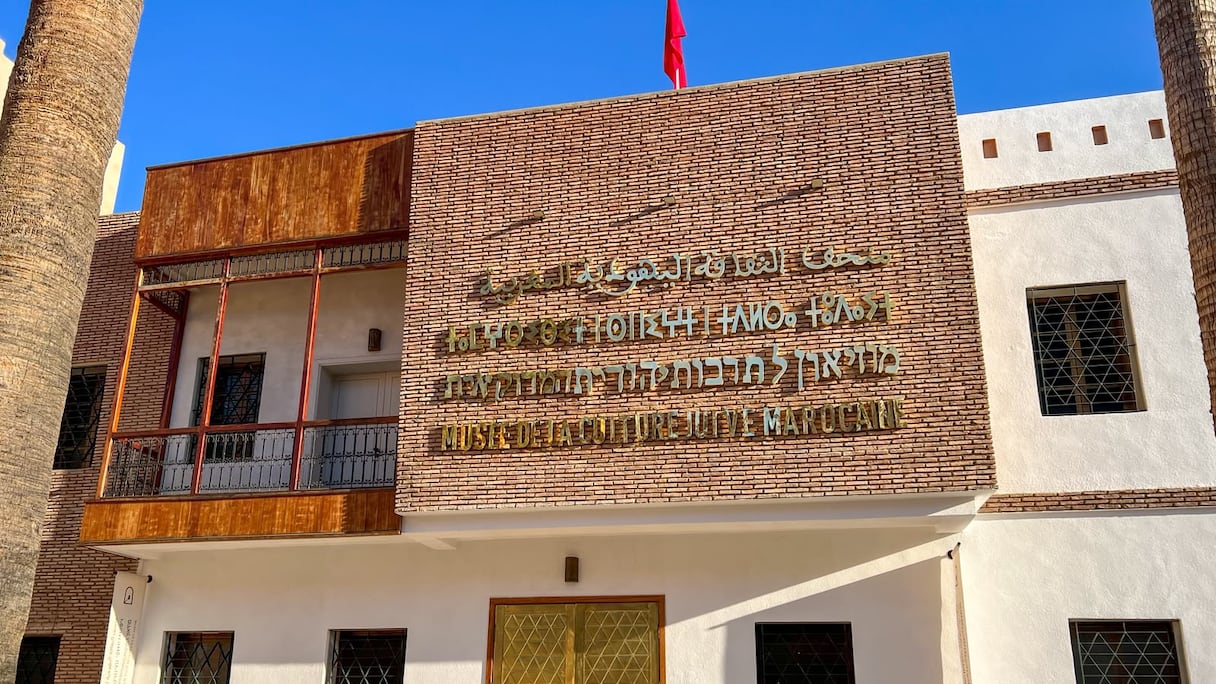
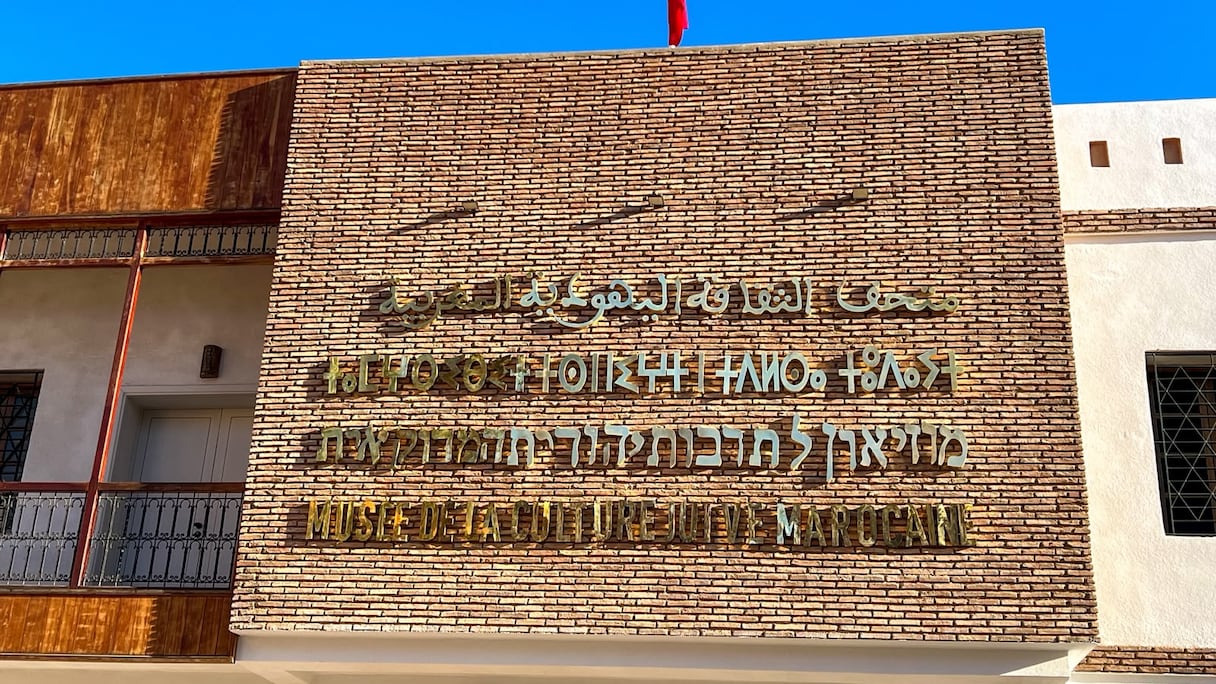
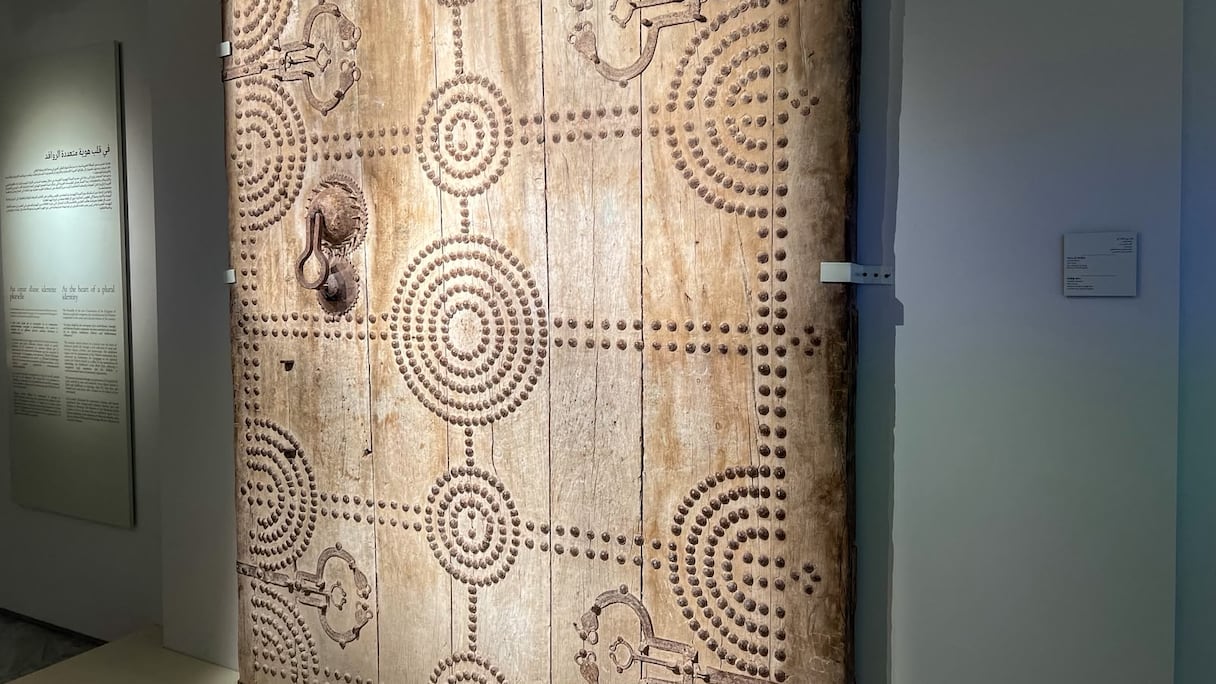
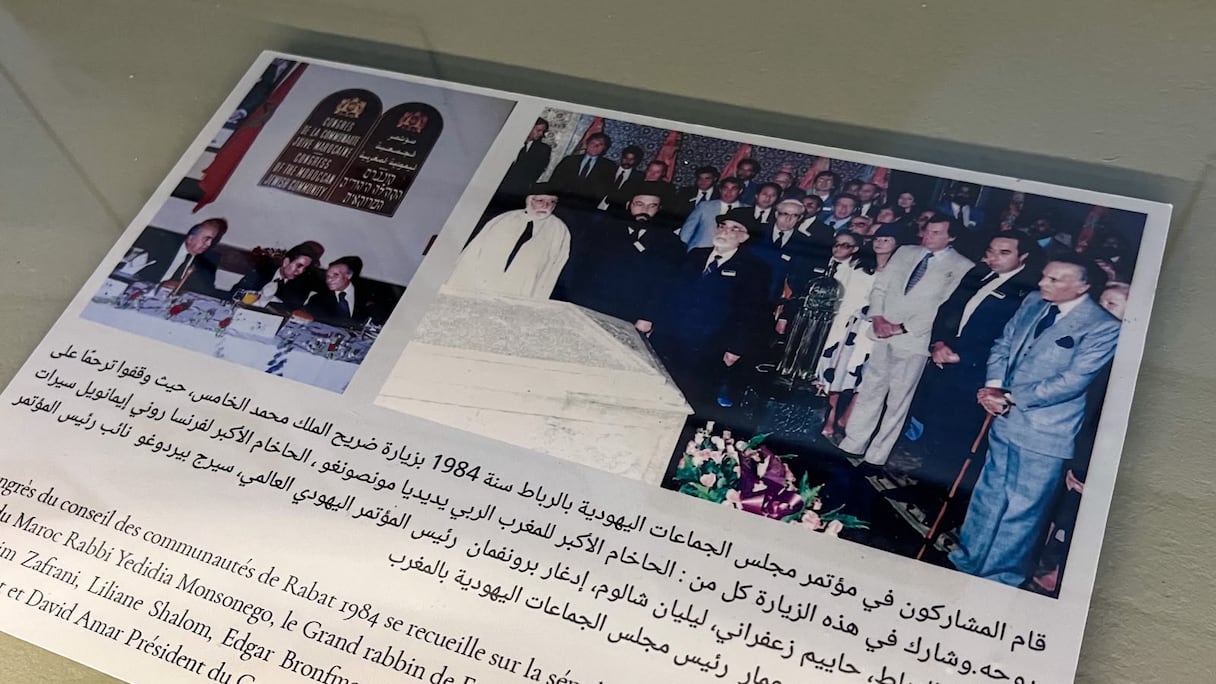
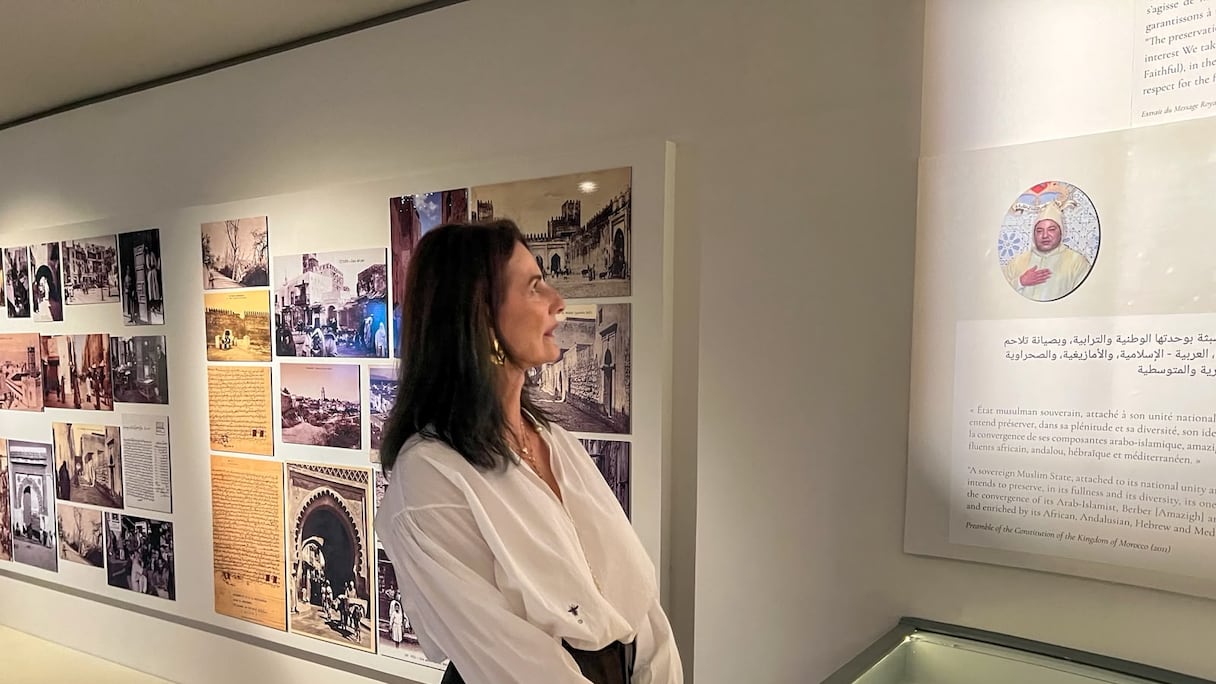
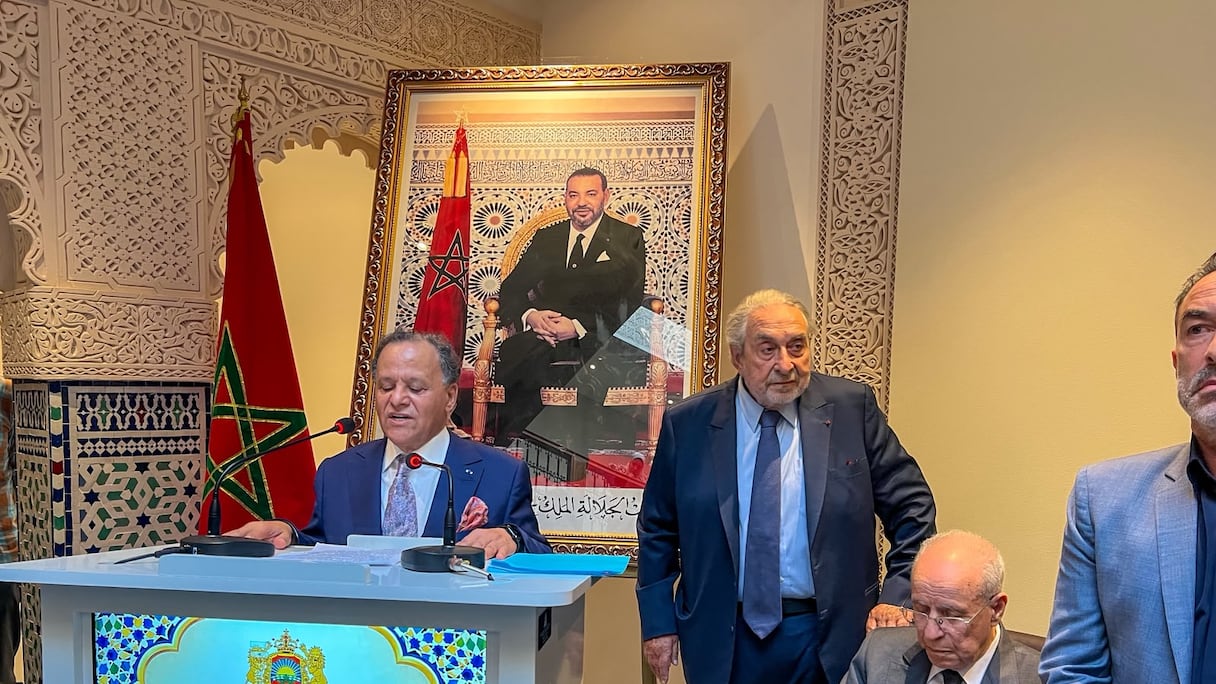
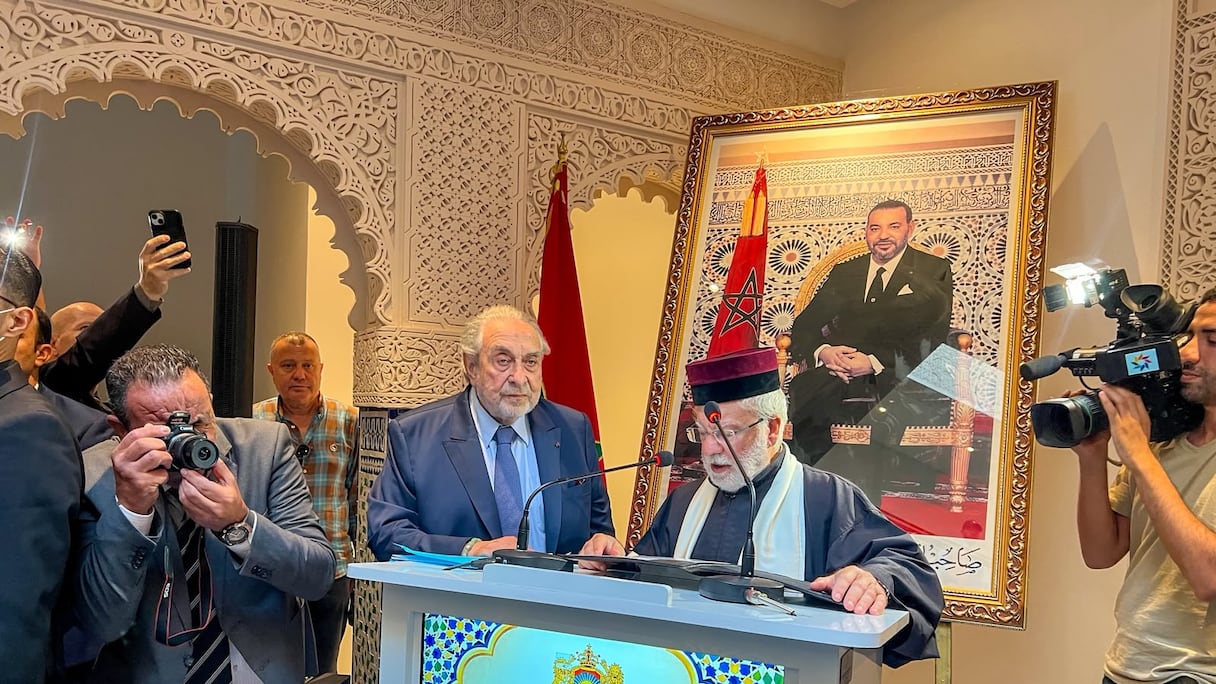
The inauguration of the Museum of Moroccan Jewish Culture in Fez on October 12, 2026. (Y. Jaoual/Le360)
Curators Zhor Rehihil and Abdelaziz El Idrissi followed the project alongside the National Foundation of Museums. The museum’s committee includes Alae Fechtali, Abir El Ouafi and Yassir Salmi, while Isabelle Timsit designed the exhibition layout.
Two museums launched on the same day in 2019
The project dates back to April 2019, when King Mohammed VI visited Fez and launched construction of the museum under a program to rehabilitate the old medina. On the same day, he also launched the restoration of the Al-Batha Palace, which became the Museum of Islamic Arts and opened to the public in 2025.
The two museums are neighbors. “As the crow flies, the Museum of Moroccan Jewish Culture is about 300 meters from the Museum of Islamic Arts,” said Mehdi Qotbi, president of the National Foundation of Museums.
Alae Fechtali, the museum’s curator, described the project as “a scientific, heritage and human endeavor of profound significance.” He linked it to the King’s vision of preserving Morocco’s different cultural traditions and passing them on to future generations.
Read also : Fes museum of Moroccan Jewish culture to open soon in the Mellah
The fact that both museum projects began on the same day was significant, he said, reflecting “an integrated vision of Moroccan heritage based on the plurality of its influences and the complementarity of its components.”
The National Foundation of Museums supervised both projects. Fechtali said they resulted in an exhibition on Islamic arts at Al-Batha and the new museum dedicated to Jewish culture, both designed to a high museographic standard. He said the foundation aims to improve the quality of historical interpretation and museum experiences across the country.
Mehdi Qotbi: “A page of our shared history”
For Qotbi, a museum represents the culmination of an idea and a carefully designed visitor experience.
Visitors, he said, are guided through “a page of our shared history, Jewish and Muslim.”
“In the world we live in today, where there are wars, it is important to see a message of peace, fraternity and love coming from Morocco,” he said.
Qotbi also discussed the collection. Nearly three-quarters of the objects on display belong to the National Foundation of Museums, he said. The foundation purchased many of the items, while others were donated.
He said the foundation had earned an extraordinary level of public trust, pointing to the large number of people visiting its museums and the growing willingness of donors to contribute objects to their collections.
Serge Berdugo: “A place of national memory”
For Serge Berdugo, secretary-general of the Council of Jewish Communities of Morocco and founding president of the Foundation for Judeo-Moroccan Cultural Heritage, the opening was deeply personal.
He described it as an important moment for Moroccan Jews and for the country as a whole.
“This museum is not dedicated solely to the memory of one community. It is a place of national memory, a space for knowledge, transmission and dialogue. It bears witness to a history deeply rooted in the Kingdom and to a Moroccan civilization built through the diversity of its components,” he said.
Read also : Fes Festival of Sufi Culture returns for 18th edition
Berdugo recalled that King Mohammed VI placed culture at the center of his vision for Moroccan society from the beginning of his reign. The King, he said, sees culture as a foundation of national identity and social cohesion, and has encouraged the preservation, modernization and transmission of the country’s heritage.
That vision recognizes Morocco’s plural identity, encompassing Arab-Islamic, Amazigh, Saharan-Hassani, African, Andalusian, Hebrew and Mediterranean influences. The King has described Amazigh identity as “a common heritage for all Moroccans without exception” and has also placed Judeo-Moroccan culture within this national framework.
Berdugo pointed to the symbolic significance of the two museum projects launched in 2019. The opening of the Jewish heritage museum, he said, reflects a cultural policy rooted in history while embracing an inclusive, modern vision of the Kingdom.
Ground-floor timeline traces 2,500 years
The museum’s permanent exhibition spans two floors and follows seven themes: “Morocco, a land of encounters,” “Chronological landmarks,” “Community institutions,” “Distinguished figures,” “The life cycle,” “The annual cycle” and “Traditional crafts.”
According to the National Foundation of Museums, the exhibition presents the social, cultural, economic and spiritual history of Moroccan Jews. It documents exchanges between Jewish and Muslim communities across the country through archaeological, ethnographic and artistic objects, as well as rare books and manuscripts.
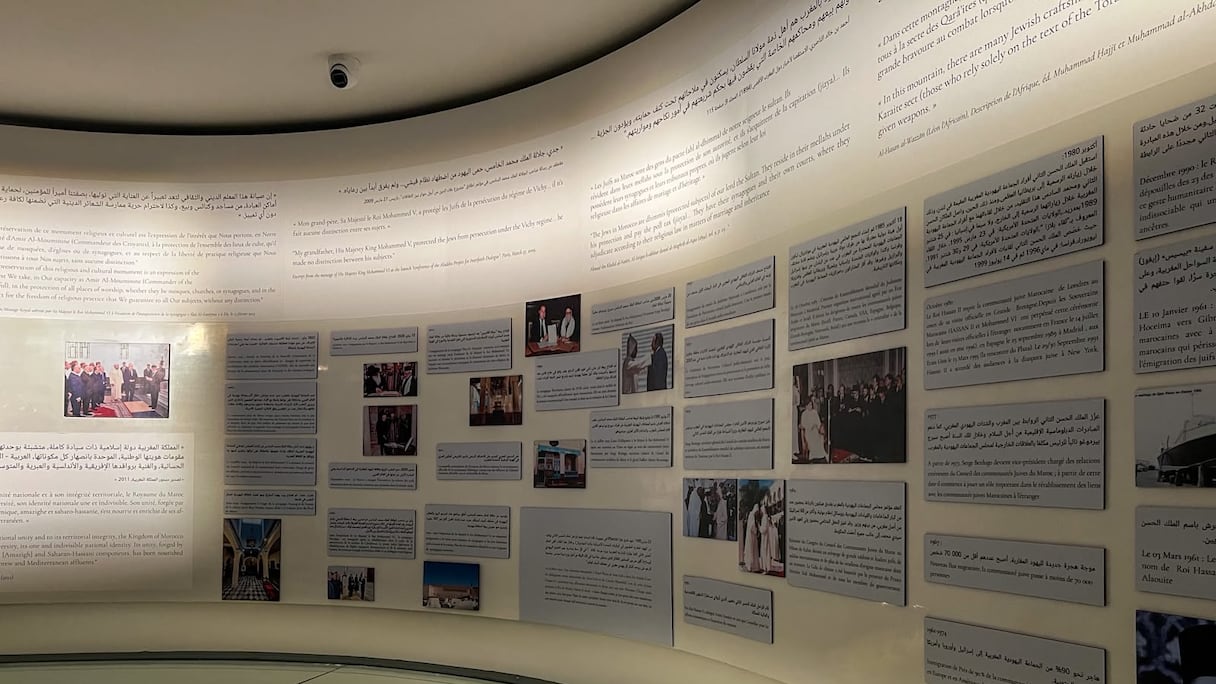
A large timeline greets visitors on the ground floor.
“We have presented the Jewish presence in Morocco over 2,500 years, then addressed the Mellah of Fez, which was founded in 1438,” Fechtali explained.
Read also : Fez-Meknes to overhaul wastewater system ahead of 2030 World Cup
The timeline begins with the earliest historical evidence of Jewish presence in Morocco, follows the history of Fez and marks the establishment of the Mellah in 1438 and the arrival of Jews expelled from Andalusia in 1492. It then traces the scientific, commercial and social life of Jewish communities through to the contemporary period.
Historical documents and audiovisual displays accompany the timeline. The foundation says the exhibition highlights the contribution of Jewish communities to the development of Moroccan society.
Elsewhere, displays introduce rabbis and prominent figures in Morocco’s rabbinic tradition, highlighting religious authorities’ role in transmitting knowledge, customs and community memory. Windows overlooking the Jewish cemetery connect the exhibition space to the actual burial grounds, giving this section a particular symbolic significance.
Another section examines community institutions and everyday life in the Mellah. It covers synagogues, Hebrew schools, rabbinical courts and daily routines, using documents, manuscripts, religious objects and ethnographic pieces to bring the history to life.
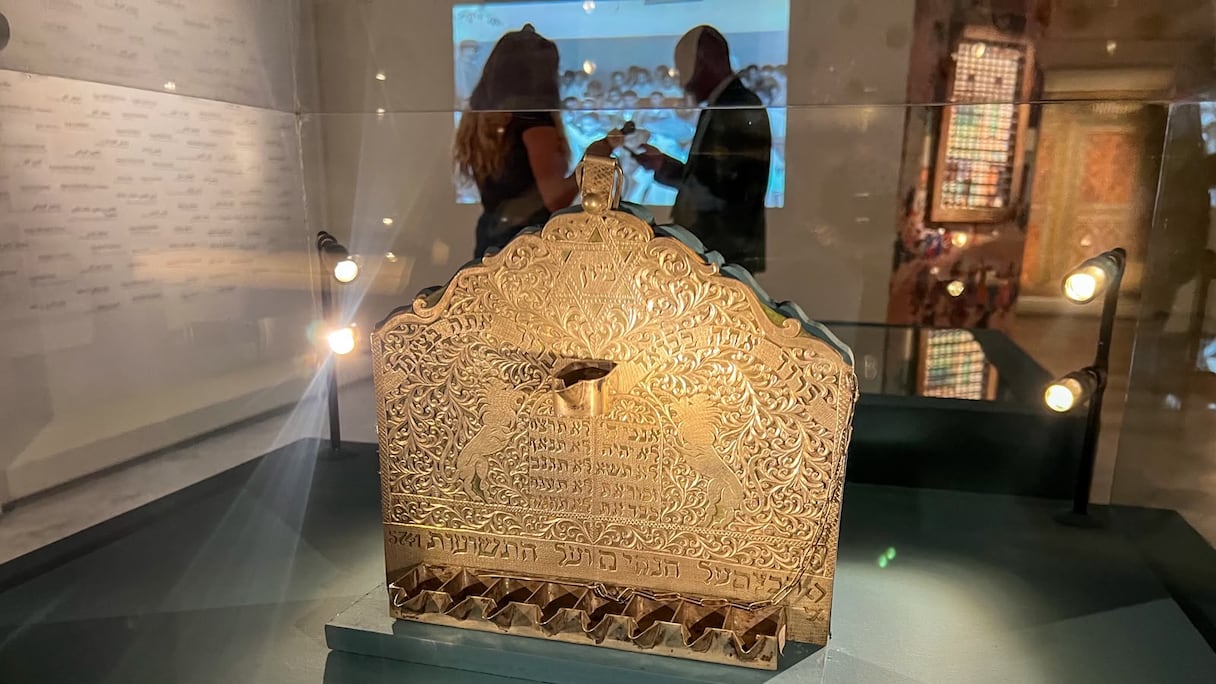
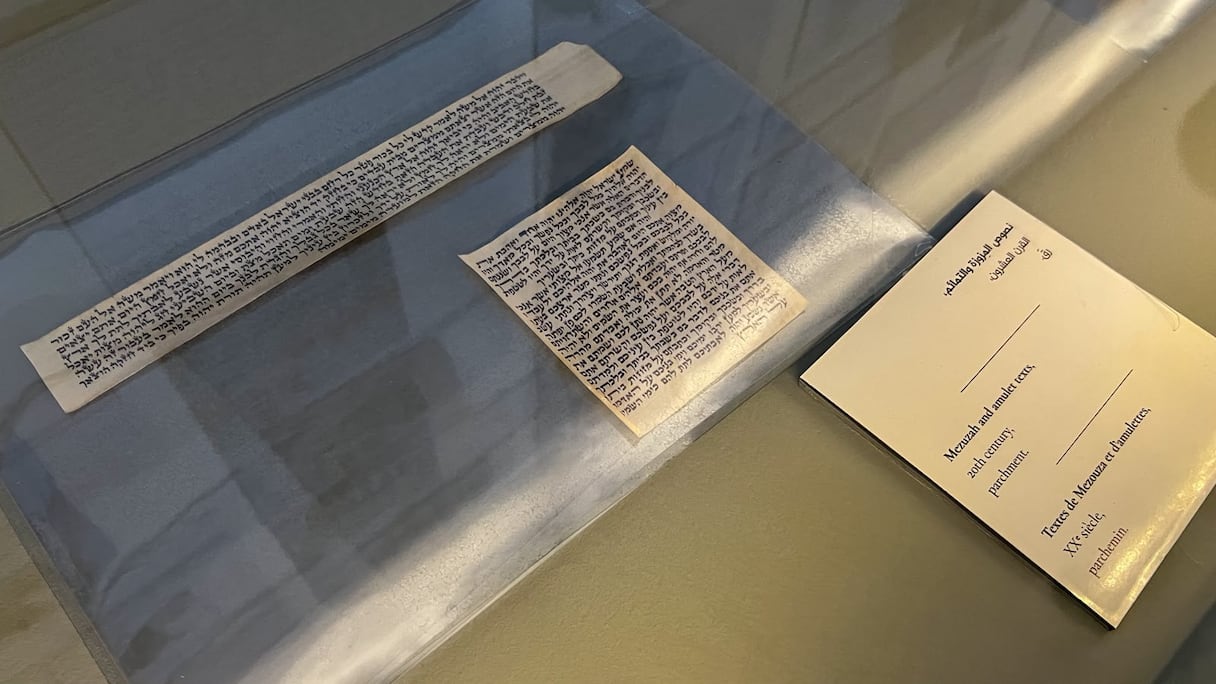
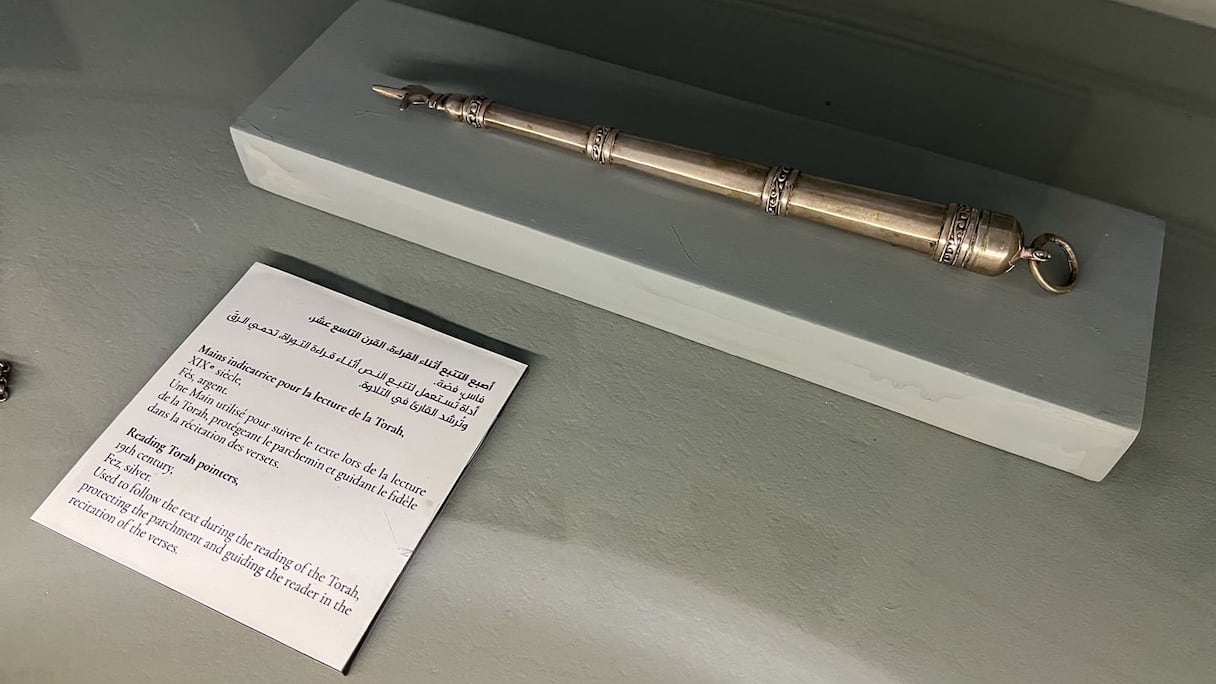
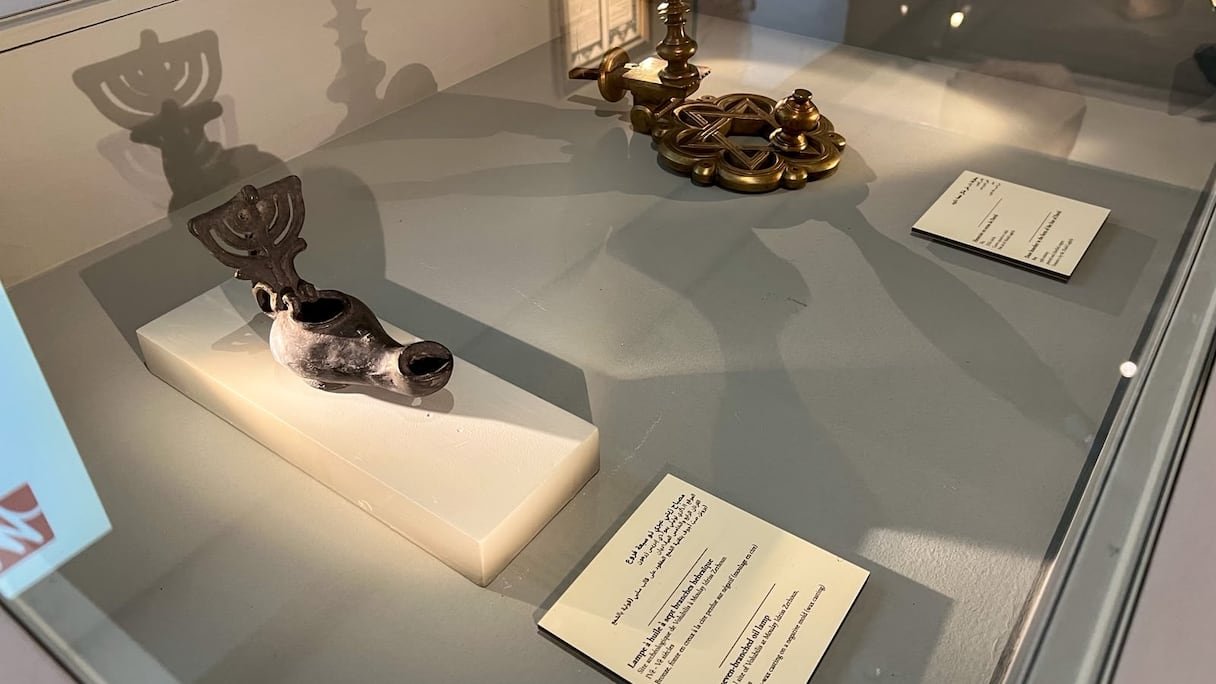
Religious objects include bags for tallit, the Jewish prayer shawl; rimonim, silver or gold ornaments placed on the tops of Torah scrolls; and a Torah scroll accompanied by an audiovisual display. Suspended lamps evoke synagogue lighting, while carved stone gravestones and memorial plaques engraved in Hebrew are displayed on a pedestal.
Nearly 180 Jewish cemeteries and shrines rehabilitated
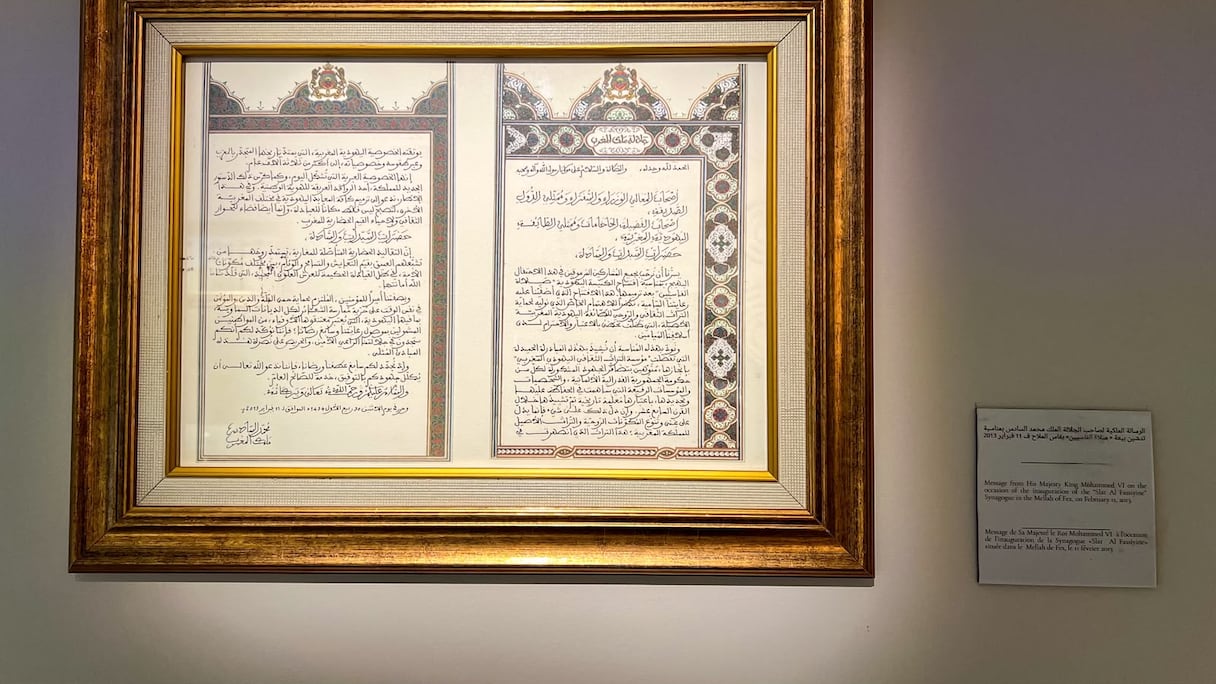
Berdugo linked the museum to King Mohammed VI’s 2013 call to restore Jewish religious sites across Morocco.
“We call for the restoration of all Jewish temples in the different cities of the Kingdom, so that they may no longer serve only as places of worship, but also as spaces for cultural dialogue and the renewal of the founding values of Moroccan civilization,” the King said at the time.
Several projects have followed. In Tangier, the Assayag Synagogue houses the Beth Yehouda Jewish Museum. Casablanca’s Ettedgui Synagogue hosts the Jewish Museum of the Old Medina, while Essaouira’s Attia Synagogue houses Bayt Dakira. In Meknes, the Rabbi Baruch Synagogue accommodates the city’s Jewish museum space. In Fez, the Ibn Danan and Slat El Fassiyine synagogues are open to the public. Other projects are underway in El Jadida, Errachidia, Gourrama and Meknes.
Read also : Fez-Meknes brings hospitals, health centers under single regional management
Berdugo said the largest undertaking has been the rehabilitation of Jewish religious and funerary heritage, carried out at the King’s initiative and under his high patronage. Nearly 180 Jewish cemeteries and shrines across Morocco have been restored, he said, opening what he called “true open-air archives” to researchers.
He then spoke about the more than two millennia of Moroccan Jewish heritage, asking for two minutes to pay tribute to its significance.
Over roughly 2,500 years, he said, Moroccan Jewish communities developed an authentic and distinctive cultural heritage that represents one facet of Moroccan civilization. It has been expressed in Arabic, Hebrew, Amazigh and Haketia, a dialect combining Arabic, Spanish and Hebrew influences. It also lives on through religious rites, traditions, food, clothing, music and craftsmanship.
Berdugo cited a statement by Minister of Endowments and Islamic Affairs Ahmed Taoufiq, delivered in New York, on the scale of this heritage:
“The intangible heritage of Moroccan Judaism is considerable, both in learned culture, including legal, theological, poetic, musical and mystical traditions, and in secular culture, including literature and language.”
Berdugo acknowledged that recognition of the responsibility to protect this legacy came late.
“We became fully aware of our moral responsibility to preserve our heritage only belatedly, so that we could strengthen its roots in the land of our ancestors and bear witness to the exceptional civilization that is Moroccan civilization,” he said.
Two institutions were established decades ago to safeguard Jewish religious sites. The Foundation for Judeo-Moroccan Cultural Heritage, recognized as a public-interest organization in 2001, works to preserve, promote and transmit this heritage. It has restored more than 20 religious sites, including cemeteries, synagogues and shrines, in cities and villages across Morocco.
Read also : New Museum in Fez explores centuries of Moroccan history through currency
The foundation has also created museums and museum spaces in Casablanca, Tangier and Meknes.
The second institution, the Jewish Museum of Casablanca, opened in 1997. Until now, it was the only Jewish museum in the Arab-Muslim world. For nearly 30 years, it has hosted exhibitions, conferences, cultural celebrations and educational events introducing visitors to the contribution of Moroccan Judaism to the Kingdom’s civilization.
Upstairs, the rituals of life and the Jewish calendar
The upper floor follows the life cycle of a Moroccan Jew, from birth to death. It explores circumcision, the bar mitzvah marking the transition to adulthood, marriage and funeral rites, showing how religious practices became woven into daily life and adapted to different regions of Morocco.
A circumcision chair displayed on a raised platform marks the entrance to the section. A dedicated display stands against yellow walls. Further along, a case devoted to marriage and religious life contains tallit prayer shawls, framed ketoubas or Jewish marriage contracts, a traditional bridal outfit known as the keswa el-kbira, and a curtain for the Holy Ark.
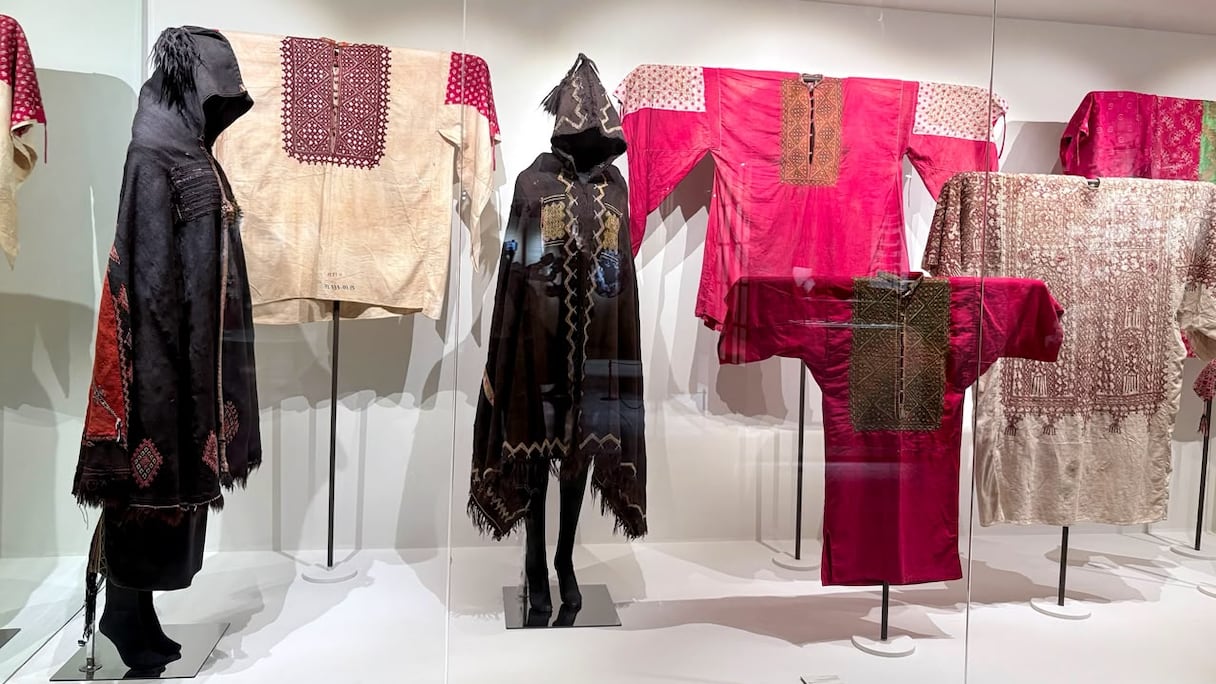
The collections also include jewelry, prayer-shawl bags and other religious objects and manuscripts. Akhnif capes, traditionally worn by men, are displayed alongside garments from the Tafilalt region.
The second section focuses on the annual cycle and Jewish holidays as celebrated in Morocco. Religious and domestic objects illustrate the place of these celebrations in family and community life.
The exhibition also highlights the intangible heritage associated with the objects: traditions, religious practices, craftsmanship, music, food, family transmission and collective memory. Torah mantles, known as meïlim, prayer-shawl bags and rimonim are displayed alongside an unfolded Torah scroll.
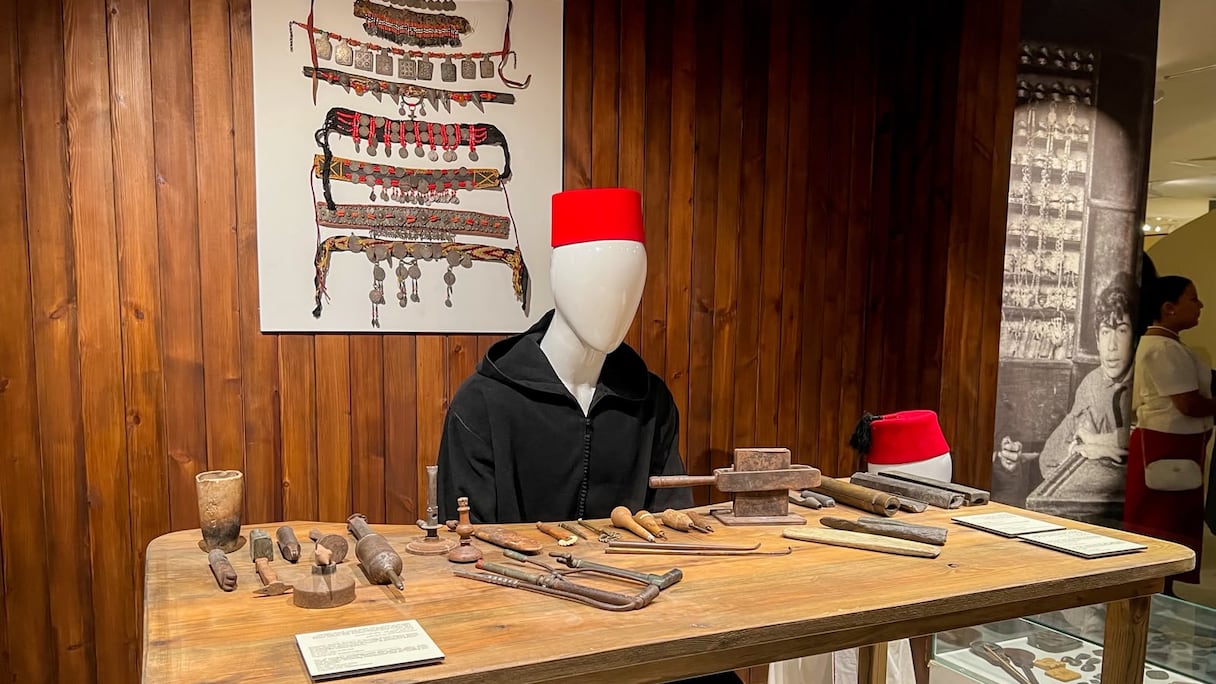
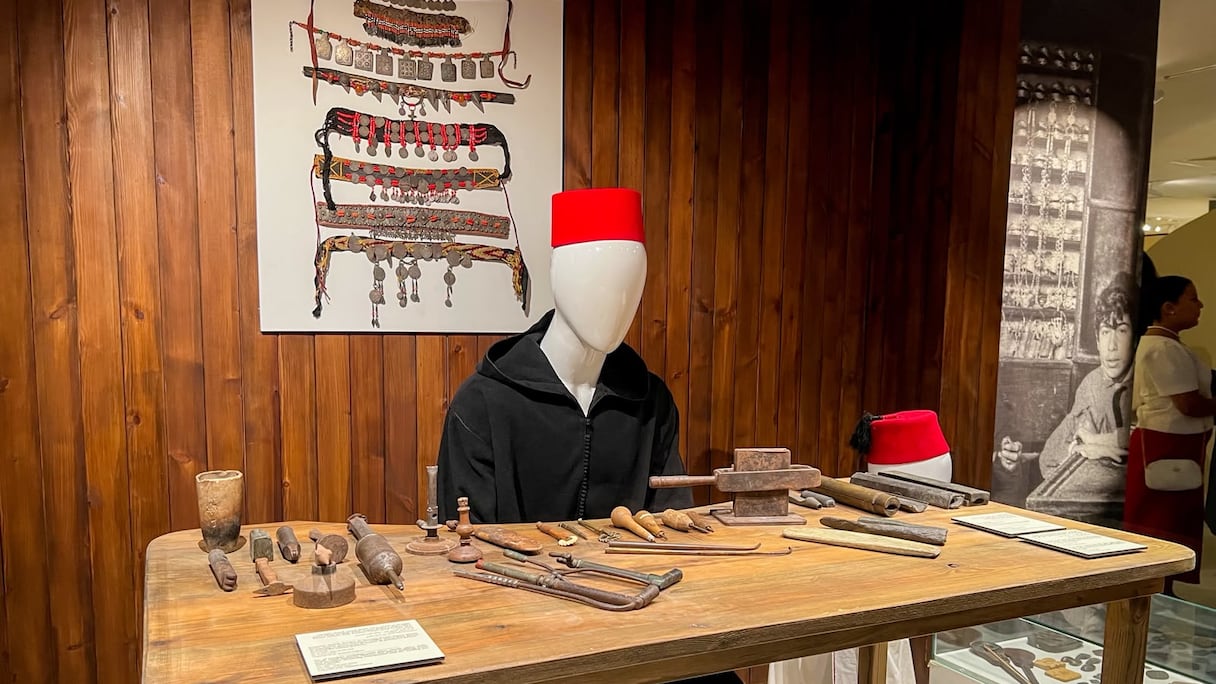
Inside the workshop of a Jewish silversmith
A substantial section is devoted to the traditional crafts of Moroccan Jewish artisans, particularly jewelry-making, an activity that long played an important role in the community.
The museum has recreated a jeweler’s workshop, complete with mannequins of artisans at work and the tools they used. Display cases contain silver necklaces, fibulae, pendants and finished pieces.
Textile crafts and weaving also feature prominently. Regional costumes and ornaments illustrate the diversity of Judeo-Moroccan clothing traditions and their social, regional and communal significance. The displays include embroidered vests, woven belts, tunics, capes and headwear. The ethnographic collection also contains elements of domestic architecture and religious objects.
The final room has burgundy walls. Copper trays, a shofar and musical instruments surround a mannequin wearing a ceremonial caftan. These instruments were used during community celebrations and gatherings.
The museum has been designed to meet current standards for conservation, security, collection management and visitor interpretation. Dedicated areas allow for preventive conservation and the monitoring of objects under appropriate conditions.
Digital tools and other visitor resources support the exhibition. The foundation describes the experience as immersive, interactive and accessible to all. The museum also plans to host educational activities and workshops for children and school groups. Its exhibition design follows the latest international standards.
Why Fez?
Berdugo said the choice of Fez was deliberate. He described the city as a place of learning, spirituality and culture, and recalled its longstanding role as a center of intellectual exchange and creativity where Jewish presence is deeply rooted.
He also paid tribute to his friend Armand Guigui, a doctor and former president of Fez’s Jewish community who helped champion the museum project.
Guigui was deeply attached to the city, its history and its heritage, and wanted its Jewish memory to have a dedicated place where it could be documented, studied and passed on. He followed the project with passion until his death at the age of 85 on December 1, 2019, nearly seven years before the museum opened.
“He unfortunately did not have the chance to see the museum completed. Today, as its doors open, his absence is especially felt. We owed him this tribute, Zikhono Li Brakha. May his memory be blessed,” Berdugo said.
He said the museum aims to make this history accessible and demonstrate the role Jewish communities played in Fez and across Morocco’s economic, cultural, intellectual and social life.
Read also : Morocco opens Currency Museum in Fez’s historic medina
The story, he added, encompasses traditions and creativity, festivals and rites, craftsmanship, and the everyday proximity and coexistence of Muslims and Jews.
“Today, the Museum of Moroccan Jewish Culture is a reality that is set to become a living showcase of Moroccan civilization in all its plurality, a cultural center for sharing and transmission, and a place of dialogue and openness rooted in the shared history of Jews and Muslims in Morocco,” he said.
Ahmed Taoufiq: coexistence even in uncertain times
Ahmed Taoufiq, minister of Endowments and Islamic Affairs, described the inauguration as evidence of Morocco’s commitment to coexistence and respect for shared values, “including in periods of uncertainty.”
The initiative, he said, is rooted in history but looks to the future, carrying a message in favor of life and closer ties between cultures. It also has symbolic significance, he added, helping communities understand one another and highlighting the diversity of Moroccan Jewish culture, including its linguistic expressions.
“The significance of this project lies in recognizing human difference and the ability to live together while respecting shared values, in accordance with the Kingdom’s spiritual frame of reference,” Taoufiq said.
