The sequence of events, as revealed by two exiled Algerian opposition figures, is straightforward. On Saturday, October 24, Abdelatif Belkaïm, a presidential adviser since 2019, boarded Air Algérie flight AH2046 from Algiers to Geneva. He returned the same day on flight AH2047. According to journalist Abdou Semmar, Belkaïm spent barely two hours on Swiss soil. At the airport, he met for 17 minutes with Rafaa Tchouka, a Switzerland-based businessman implicated in the Bencheikh affair, before passing back through security and returning to Algiers.
Saïd Bensedira broke the story that evening during a livestream on his Flash News TV channel, presenting photographs and flight details. The images show the presidential emissary pulling a suitcase, riding an escalator, speaking to his contact with a phone to his ear and then bidding him farewell. Abdou Semmar subsequently reported further details in two broadcasts. According to Semmar, the trip was made without official travel authorization or any declared professional purpose, and the intelligence services had reportedly not been informed.
The identity of the traveller makes the episode particularly serious. A former journalist, Abdelatif Belkaïm was a key figure in Abdelmadjid Tebboune’s 2019 presidential campaign communications team. He now works closely with the presidency’s communications directorate and Tebboune’s private office, handling several sensitive political and security matters overseen by El Mouradia, the presidential palace. Semmar describes him as one of the president’s “five or six most influential advisers.”
The identity of the man he met makes the encounter more consequential still. The Farid Bencheikh affair, named after Algeria’s former director-general of national security, is being investigated by the Blida military court on charges of high treason, espionage and conspiracy against the state. Rafaa Tchouka, the man Belkaïm met in Geneva, is suspected of playing a role in setting the case in motion. He allegedly obtained Saïd Bensedira’s phone during an altercation in the Paris region and passed it to people close to Bencheikh. The alleged objective, according to Semmar, was to search the device for material that could be used to implicate senior intelligence officials, military prosecutors and members of the army high command. Tchouka is the subject of legal proceedings in France, while an arrest warrant has reportedly been issued against him in Algeria.
Nobody knows what was discussed during those 17 minutes. Neither Abdelatif Belkaïm nor the presidency has commented publicly. But the question goes beyond what the two men may have exchanged. Why would a close presidential aide board a plane to meet, face to face and on neutral territory, a man wanted by his own country’s military judiciary?
That is where the episode becomes more than an isolated incident. The Bencheikh case was never simply a police matter. The former head of the Directorate-General of National Security (DGSN) was engaged in an open power struggle with several pillars of Algeria’s security establishment: the Directorate of Internal Security, then headed by General Abdelkader Haddad, known as Nacer El Djinn, who has since been arrested and imprisoned; the Directorate of Documentation and External Security; and the Blida military prosecutor’s office. Bencheikh told military investigators that he had acted on instructions from the presidency, naming the president’s former chief of staff, the late Boualem Boualem. For Semmar, the Geneva photographs confirm “complicity at the very highest levels of Tebboune’s inner circle.”
The leak itself sends a message. According to Semmar, Belkaïm could not have made the trip without Tebboune’s approval. He was probably followed from Algiers by operatives who, the journalist argues, could only have belonged to the intelligence services. The photographs were allegedly passed deliberately to Bensedira to trigger a public scandal, because a discreet investigation into a presidential adviser was not possible. Making the affair public would force the presidency to act.
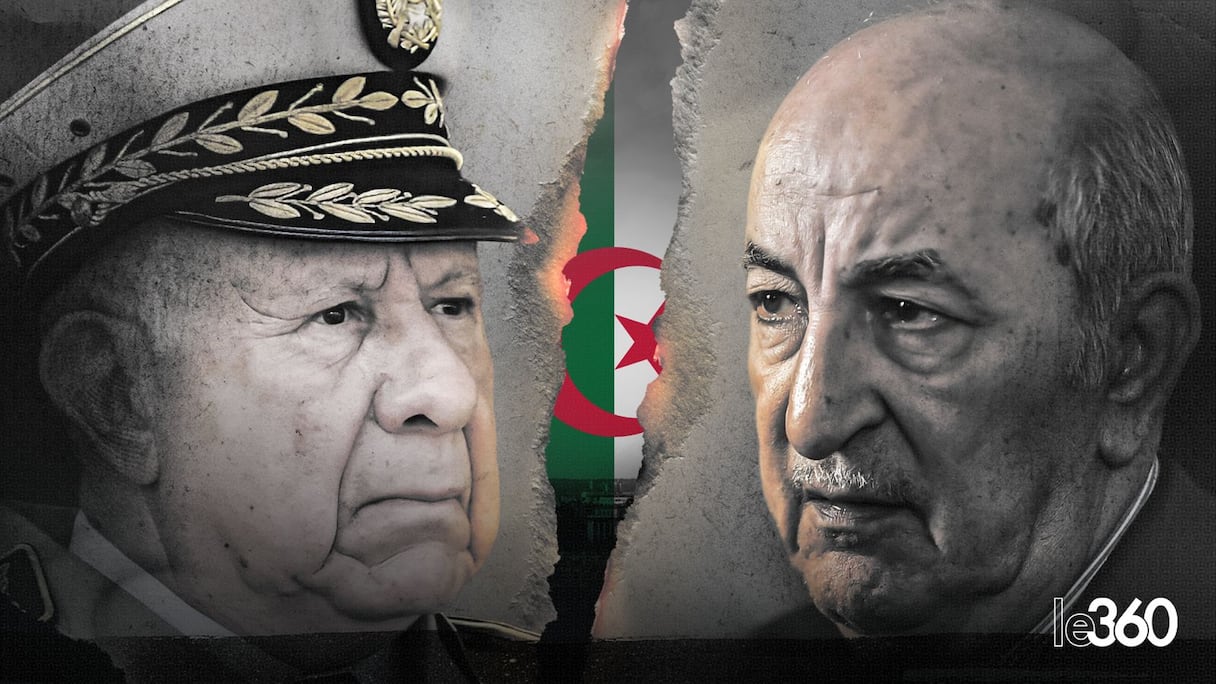
It would be a mistake to dismiss the episode as a curiosity. For seven years, successive purges have swept through Algeria’s security establishment: intelligence chiefs dismissed, generals arrested and former police commanders prosecuted. Each faction sees the other’s hand behind the upheaval. The Geneva trip provides, for the first time, a visual record of what many had long suspected: a man from the presidency in direct contact with a figure at the center of the affair pitting Tebboune’s camp against the military.
The timing makes the episode even more troubling. The trip took place on the eve of the extraordinary parliamentary session that authorized the deployment of Algerian troops to Niger. Just as the military assumes an unprecedented role in the country’s affairs, extending its reach beyond Algeria’s borders, the presidency finds one of its own aides exposed by photographs leaked from within the system.
The affair will have consequences. Either military intelligence summons the Geneva emissary, bringing the conflict between El Mouradia and the army high command into the open, or nothing happens, leaving an unavoidable conclusion: either the presidency is powerful enough to protect its own, or the military is too weak to challenge it. In either case, Algeria’s regime no longer looks like the united front it claims to be, but rather two competing centers of power watching, photographing and bringing each other down.
In Algiers, foreign powers are routinely accused of trying to divide the state. Yet it took just two hours in Geneva to show that the divisions are already within its own walls.
