
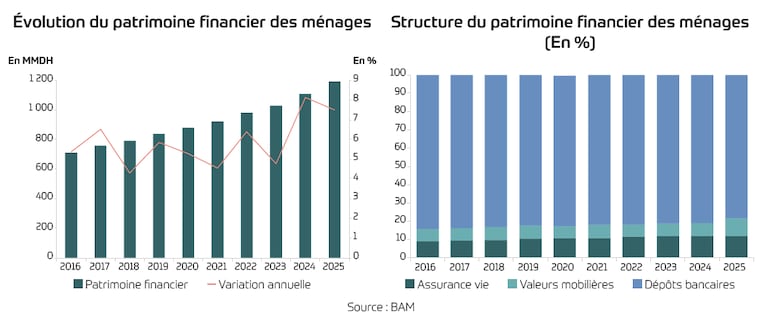
According to the 2025 Financial Stability Report, published by Bank Al-Maghrib, the Moroccan Capital Market Authority, and the Insurance and Social Security Supervisory Authority (ACAPS), Moroccan households’ financial wealth rose by 7.5% in 2025, reaching MAD 1.192 trillion, following an 8.1% increase in the previous year.
The report attributes this growth to gains across all asset categories, indicating stronger household financial savings capacity and increasing diversification of investments into market-based assets.
Household bank deposits reached MAD 935 billion by the end of 2025, an increase of 4.5%, compared to 7.5% growth in 2024. They continue to be the largest component of household financial assets, representing nearly 79% of the total.
Deposits held with participatory (Islamic) banks reached MAD 13 billion, increasing by 13.4%. The report notes that this sustained expansion has continued since the sector’s launch in 2019, when deposits totaled just MAD 2 billion.
Evolution of household financial wealth and its composition.
Current accounts continued to drive deposit growth, rising 6.6% to MAD 658 billion, after expanding 10.1% in 2024. They now represent 70% of all household bank deposits.
Savings accounts also showed moderate growth of 2.6%, reaching MAD 190 billion, while maintaining a stable 20% share of total household deposits.
Term deposits continue to decline
The report highlights a continued decline in household interest in term deposits, extending a structural trend observed over the past decade.
Outstanding term deposits fell from MAD 103 billion in 2016 to MAD 77 billion in 2025, representing a cumulative decline of nearly 25%. Their share of total household bank deposits dropped from 17.2% to 8.2% over the same period.
According to the report, this decline reflects lower returns on term deposits, households’ growing preference for liquid assets, and the gradual reallocation of savings toward alternative financial investments.
Evolution and composition of household bank deposits.
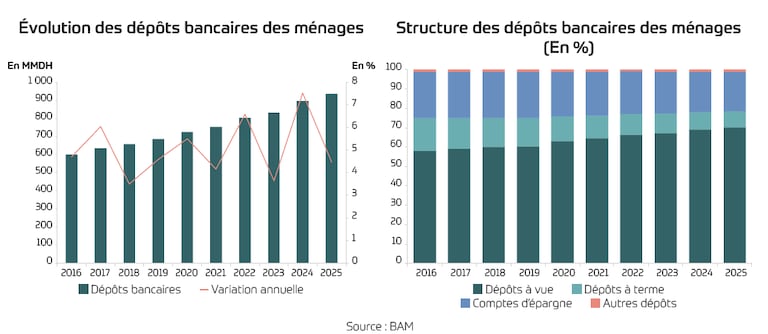
This gradual shift in household savings preferences is also reflected in the banking sector’s funding structure. Term deposits now account for less than 9% of banks’ funding resources, compared with 22% a decade ago.
Beyond bank deposits
Household investments in life insurance contracts increased by 7.9% in 2025 for the second consecutive year. However, their share of total household financial wealth remained stable at around 12%.
Investments in securities recorded the strongest performance, surging 40.1% in 2025 after a 15.5% increase in 2024, to reach MAD 114 billion. As a result, their share of household financial assets rose from 7.3% in 2024 to 9.4% in 2025.
The report notes that these investments remain overwhelmingly concentrated in equities, which account for nearly 97% of total securities holdings after increasing 43.2% to MAD 111 billion.
Private bond holdings continued to decline, falling 36.6% to MAD 2 billion, reducing their share from 4.2% in 2024 to 1.9% in 2025.
Meanwhile, household holdings of government securities, although still modest, more than doubled, rising from MAD 373 million to MAD 780 million.
