The global automotive industry is undergoing a period of profound change, driven by stricter environmental requirements as part of efforts to combat climate change, intensifying international competition, and the rise of protectionism. According to Bank Al-Maghrib (BAM) in its 2025 annual report, these developments are also affecting Morocco’s automotive industry.
As the report explains, since the adoption of the Paris Agreement in 2015, many countries have gradually incorporated climate objectives into their public policies. In Europe, the regulatory framework governing the automotive sector has been progressively strengthened to decarbonize road transport, with the goal of achieving carbon neutrality by 2050.
In this context, ambitious targets for reducing CO₂ emissions from new vehicles were established under the “European Green Deal and Regulation (EU) 2019/631,” adopted in 2019 and revised in 2023 as part of the “Fit for 55” legislative package. In response to challenges facing the industry, however, the European Commission presented an “automotive package” in December 2025 that eases emissions standards through 2035 while maintaining the objective of carbon neutrality.
Read also : Stellantis Expands Its Kénitra operations with the Fiat Grizzly and Fastback
At the same time, Bank Al-Maghrib says China’s rapid expansion in the new energy vehicle (NEV) segment, driven by supportive public policies and significant investment in research and development, has resulted in production overcapacity.
This trend has enabled the Asian country to strengthen its presence in international markets, particularly in Europe. To counter this expansion, the European Union imposed countervailing duties in 2024, for a period of five years, ranging from 7.8% to 35.3%, depending on the manufacturer, on imports of battery electric vehicles from China.
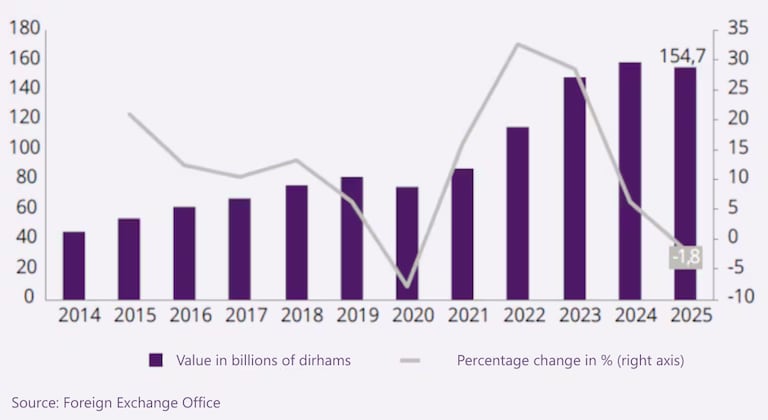
National exports from the automotive manufacturing segment (Source: BAM)
Bank Al-Maghrib also points to rising protectionism and intensifying trade tensions between China and the United States. For the automotive industry, these developments have led to higher production costs, as well as disruptions and a reconfiguration of supply chains.
In Morocco, the central bank says the automotive industry has gradually established itself as a major hub in Africa, supported by the presence of major international manufacturers and the development of an ecosystem bringing together numerous suppliers.
The sector is now entering a new phase with investments in electric battery manufacturing and the establishment of research and development (R&D) centers, with the objective of positioning the Kingdom among the global producers of electrified vehicles.
Stronger competition from China
According to Bank Al-Maghrib data, automotive exports grew at an average annual rate of 11.8% between 2014 and 2025. The sector became Morocco’s leading export industry, accounting for 33% of total exports in 2025. This performance reflects the strong growth of the wiring and vehicle manufacturing segments, which represented 37% and 40% of the sector’s exports, respectively.
To assess Morocco’s position in the European market, the report’s authors compared the Kingdom’s passenger car export volumes with those of its main competitors: Spain, Turkey, Romania, Poland, Slovenia, Hungary, and South Africa. These countries were selected because their export volumes are relatively close to Morocco’s and because a large share of their exports is destined for the European Union. Spain, whose exports total 1.4 million vehicles—significantly higher than Morocco’s—was nevertheless included in the analysis because it competes directly with Morocco in certain vehicle segments produced by Stellantis.
European passenger car imports from Morocco’s main competitors (by volume) (Source: BAM)
The comparison shows that during the pre-pandemic period (2014-2019), EU passenger car imports from these countries recorded sustained growth. Over the past three years (2023-2025), however, markedly different trends have emerged, according to Bank Al-Maghrib. The central bank says these developments reflect both the gradual shift in European demand toward less-polluting vehicles and the growing competition from China, whose share of the EU’s automotive imports rose between the two periods from an average of 0.7% to 6.5% overall, and from 14% to 20% in the electric vehicle segment alone.
Read also : World Bank says Morocco records strongest economic growth in a decade
According to Eurostat data cited by the central bank, exports from Morocco, Romania, and South Africa to the EU, which remain concentrated by nearly 90% in the internal combustion engine vehicle segment, have slowed significantly. Morocco and Romania posted average annual growth rates of -1.5% and -3.3%, respectively, compared with 15.3% and 14.4% during the 2014-2019 period. South Africa also recorded a sharp slowdown, with growth falling from 27.4% to 1.8%.
Even Spain, where the share of internal combustion engine vehicles in exports declined from 99% to 67%, saw export growth slow from 6.6% during the earlier period to 2.5%. Growth in hybrid vehicles only partially offset the decline in internal combustion engine vehicles.
European passenger car imports from Morocco’s main competitors by powertrain type (by volume, 2023-2025 average) (Source: BAM)
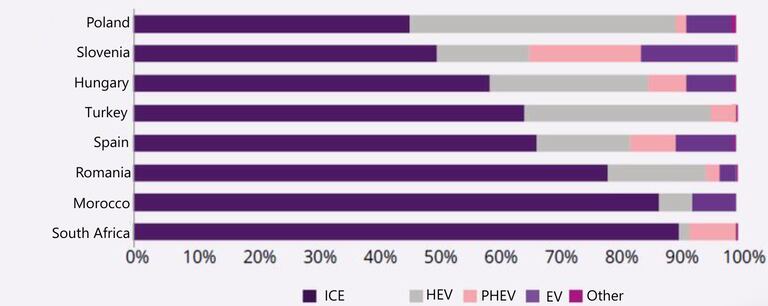
By contrast, Slovenia recorded a notable acceleration, with growth rising from 5.6% to 42%, driven by alternatively powered vehicles, which now account for half of its exports, compared with just 2% during the pre-pandemic period.
Hungary posted a slight increase, from 5% to 5.1%, driven by the electric vehicle segment, while Poland’s growth rose from 4.4% to 5%, linked to an increase in hybrid vehicles.
Turkey, meanwhile, where the share of alternatively powered vehicles increased from 11% to 35%, maintained export growth despite a slowdown, with growth declining from 11.2% to 4%.
A complex international environment
In the medium term, Bank Al-Maghrib says in its 2025 annual report that Morocco’s automotive sector is expected to continue operating in a complex international environment, characterized by intensifying competition in the European market, particularly from China, as well as from other new entrants as the European Union diversifies its trade partnerships, including with Mercosur and India.
The central bank adds that protectionism is also expected to continue rising through increased use of measures designed to support the competitiveness of the European automotive industry, as illustrated by the proposed Industrial Accelerator Act (IAA), presented by the European Commission in March 2026 to promote products manufactured in Europe.
Nevertheless, Bank Al-Maghrib concludes in its analysis that “despite this environment, the national automotive industry should be able to continue its development and preserve its competitiveness thanks to efforts made to attract foreign direct investment in strategic segments, as well as the shift toward electrification and the strengthening of the local content of exports.”
