
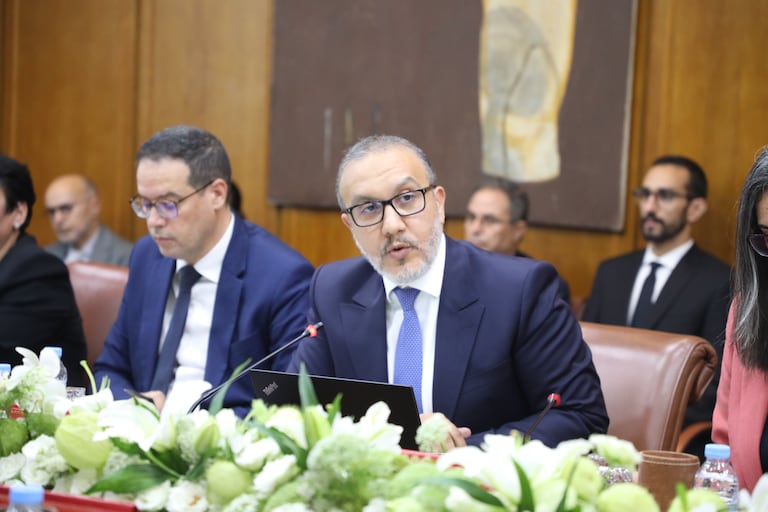
Economy and Finance Minister Nadia Fettah opened the board meeting by highlighting the importance of the session as Morocco faces major challenges related to the energy transition and water security. She praised ONEE and its staff for implementing King Mohammed VI’s directives on energy, water, and sustainable development.
ONEE Director General Tarik Hamane said the electricity and drinking water sectors are undergoing profound changes, stressing the utility’s efforts to address growing water scarcity, rising demand, and the increasing volatility of fuel and commodity prices.
Hamane said ONEE’s action plans will place greater emphasis on supporting Morocco’s decarbonization efforts and encouraging private investment. The utility has also launched several strategic initiatives to modernize its operating model, improve governance, and strengthen management tools.
Reviewing ONEE’s 2025 performance, Hamane said the utility completed a major investment program that increased Morocco’s installed electricity generation capacity to 12,314 megawatts (MW), with renewable energy accounting for 46.1% of the total. The figure brings the country closer to its target of raising renewables to more than 52% of installed capacity by 2030.
In the water sector, equipped drinking water production capacity reached 7.5 million cubic meters per day. ONEE also commissioned a new desalination plant in Sidi Ifni in February 2025 with an annual capacity of 3.15 million cubic meters, bringing the number of desalination plants developed by the utility to 13, with a combined annual capacity of 88.4 million cubic meters.
In 2025, ONEE met electricity demand, which reached 49 terawatt-hours (TWh), up 7.4% from the previous year. Peak demand climbed to 7,990 MW in August 2025 before reaching a new record of 8,400 MW in July 2026, an increase of 410 MW, or 5%, in one year.
The utility produced 1.417 billion cubic meters of drinking water in 2025, including 977.8 million cubic meters from surface water, 367.2 million cubic meters from groundwater, and 72.5 million cubic meters from seawater desalination.
Construction of the Casablanca desalination plant—the largest in Africa and one of the world’s largest, with a total capacity of 300 million cubic meters per year—has reached 81% completion for its first 200 million cubic meter phase. The facility is scheduled to begin operations on February 1, 2027.
Read also : New water projects to improve drinking water supply for over 650,000 people in and around Khouribga
MAD248 billion investment plan
Hamane then presented ONEE’s 2026-2030 investment plan, which focuses on projects designed to accelerate Morocco’s energy transition through the large-scale integration of renewable energy, expanded electricity storage and system flexibility, and reinforcement and expansion of the national transmission grid.
According to ONEE, the plan will enable Morocco to exceed its target of sourcing 52% of installed electricity capacity from renewable energy as early as 2028.
The program carries a total investment of more than MAD248 billion for 2026-2030, including MAD206 billion for electricity projects and MAD42.1 billion for drinking water infrastructure. Around 72% of the funding is expected to come directly from the private sector.
The plan includes MAD104 billion in renewable electricity generation projects that will add 11.6 gigawatts (GW) of renewable capacity and 2.6 GW of additional storage, representing about 80% of the total new generating capacity planned during the period.
To support the growing share of renewable energy, ONEE plans to invest in storage and system flexibility through battery energy storage systems (BESS) with a combined capacity of 2,230 megawatt-hours (MWh), the 360 MW El Menzel pumped-storage hydropower plant, and a 3,744 MW natural gas flexibility program. The utility said these projects will facilitate renewable energy integration while ensuring the stability and reliability of Morocco’s electricity system.
Expanding water security
In the drinking water sector, the 2026-2030 investment program focuses on securing water production, expanding supply in rural areas, and improving the efficiency of existing production networks.
Once completed, Morocco’s drinking water desalination capacity is expected to exceed 1.3 billion cubic meters annually, meeting 63% of the country’s drinking water needs, compared with 13% in 2025 and less than 8% in 2023.
Major desalination plants planned under the program include facilities in Casablanca, the Oriental region, Tangier, Souss-Massa, and Guelmim/Tan-Tan.
At the conclusion of the meeting, the board approved all proposed resolutions, saying they align with ONEE’s objectives of expanding its activities while improving its technical and managerial performance.