Rumors surrounding the recent decline in gas flows to Morocco via Spain, amid the Ceuta migration crisis, have once again highlighted a structural vulnerability in the Kingdom’s supply system. While no link has been established between the two events and Madrid has denied any intention of using gas as a means of pressure, Morocco’s dependence on infrastructure located in Spain raises, over the longer term, the question of its energy sovereignty.
Against this backdrop, the LNG terminal and FSRU project at Nador West Med retains all its strategic importance. But six months after the tender for the project was suspended last February, where does the project actually stand?
“The project is moving forward and is currently being recalibrated. The tender is being amended, and work is continuing,” a source at the Ministry of Energy Transition and Sustainable Development said.
The clarification comes after the suspension of the procedure, announced on February 3, 2026, raised numerous questions about the future of the infrastructure. At the time, the ministry justified its decision by citing the emergence of “new parameters and assumptions” relating to the project, without providing further details as to their nature.
The process has therefore not been abandoned. Adjustments are currently being made to take account of the new parameters before the procedure is relaunched.
According to the same source, this type of revision is nothing exceptional for infrastructure of this scale. “These are standard things that happen with projects this large, which sometimes need to be recalibrated,” the source explained.
The aim is to review the various components of the project in order to establish a structure suited to the new assumptions and ensure its long-term viability.
With legislative elections three weeks away, the project is set to be handed over to the next government, which will have to take over and implement it. “It will be up to the next government to bring the project to fruition,” the same source said, stressing that meetings are continuing and that the infrastructure remains part of the Kingdom’s energy roadmap.
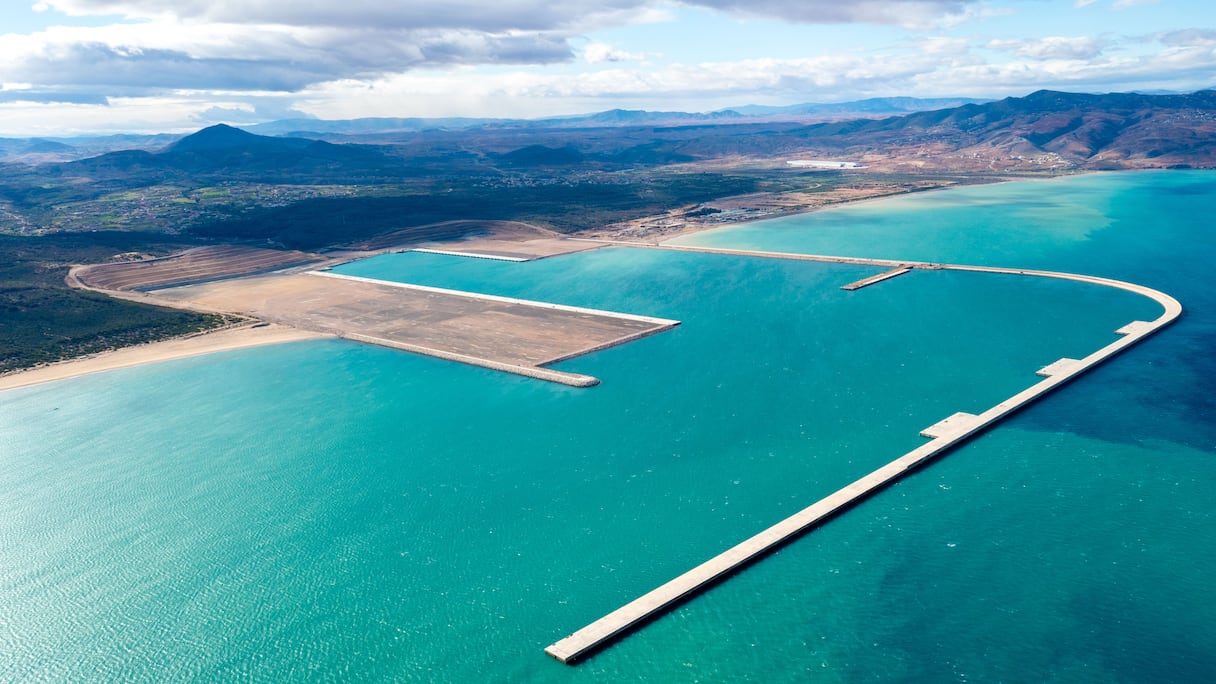
The Nador West Med port is intended to become Morocco’s first true maritime gateway for liquefied natural gas. The initial plan notably provides for an LNG terminal equipped with a floating storage and regasification unit (FSRU), as well as a network of gas pipelines connecting the port to the Maghreb-Europe Gas Pipeline (GME), and then linking the GME to the Kingdom’s main industrial and energy hubs.
The tender launched in December 2025 specifically covered the development of the LNG terminal and the infrastructure required to connect it to the GME and the industrial zones of Kenitra and Mohammedia. The project represents an investment of around $1 billion for this first phase.
Its strategic importance was clearly underscored at the working meeting chaired by King Mohammed VI on January 17, 2026, devoted to the Nador West Med port and industrial complex. The port’s energy hub was notably set to host the Kingdom’s first LNG terminal, with an announced capacity of 5 billion cubic meters per year.
The tender was suspended just days after that meeting, further fueling questions about the project’s future.
The issue, however, extends beyond the construction of a terminal in Nador. It concerns the Kingdom’s entire gas supply chain.
Today, Morocco purchases LNG on international markets, notably from the United States and Peru. But the gas must be received and regasified at Spanish terminals before being transported to the Kingdom via the GME, reaching the gas-fired power plants at Tahaddart, near Tangier, and Ain Beni Mathar, near Jerada.
This configuration means that part of the logistics chain remains dependent on infrastructure located outside the country.
This structural vulnerability should, however, be distinguished from the recent change in import volumes. As we reported in a previous article, the decline observed in recent days was not caused by the Sebta migration crisis. It was mainly due to lower electricity demand following the summer peak.
Electricity demand thus fell from around 8,400 MW at the beginning of July to some 7,400 MW toward the end of August, a decline of nearly 1,000 MW. Reduced activity at gas-fired power plants mechanically lowered their fuel requirements. No restrictions on the Spanish side had been reported.
The Ceuta crisis therefore did not trigger an energy crisis between Rabat and Madrid. It nevertheless revived a fundamental question: how far can Morocco rely on foreign infrastructure to secure its gas supplies?
The question comes as Morocco’s natural gas demand is expected to increase in the coming years.
Industrial development, the conversion of some power-generation capacity and changes in the energy mix are likely to increase gas requirements. At the same time, the Kingdom is seeking to gradually reduce its dependence on coal and accelerate the development of renewable energy.
In this equation, gas is expected to play a transitional and flexibility role, particularly in supporting the growing integration of renewable energy into the electricity system.
The Nador West Med terminal is designed precisely to meet this ambition. It is intended to allow Morocco to import LNG directly from international markets, store and regasify it on its own territory, and then inject it into the national network.
Three imperatives therefore underpin the project: meeting rising gas demand, supporting the evolution of the energy mix and reducing dependence on infrastructure located abroad.
That is precisely what makes the February suspension particularly intriguing. While the project is described as strategic and remains firmly on the agenda, the precise reasons that led to the suspension of the procedure remain, several months later, largely unexplained.
It is this grey area that continues to fuel questions surrounding the project’s timetable and its new structure.
Nevertheless, the strategic nature of the infrastructure does not appear to be in question. “The project is strategic; it must be completed,” the same source insisted.
