The famous Moroccan proverb, “Ach khssek al’aryan? Khatm a moulay” (“What does a naked man need? A ring, my lord”) almost perfectly captures the debate currently gripping Moroccan football. While the Botola has been struggling with far more pressing problems for years, some of its stakeholders appear to have found the miracle reform: increase the number of clubs.
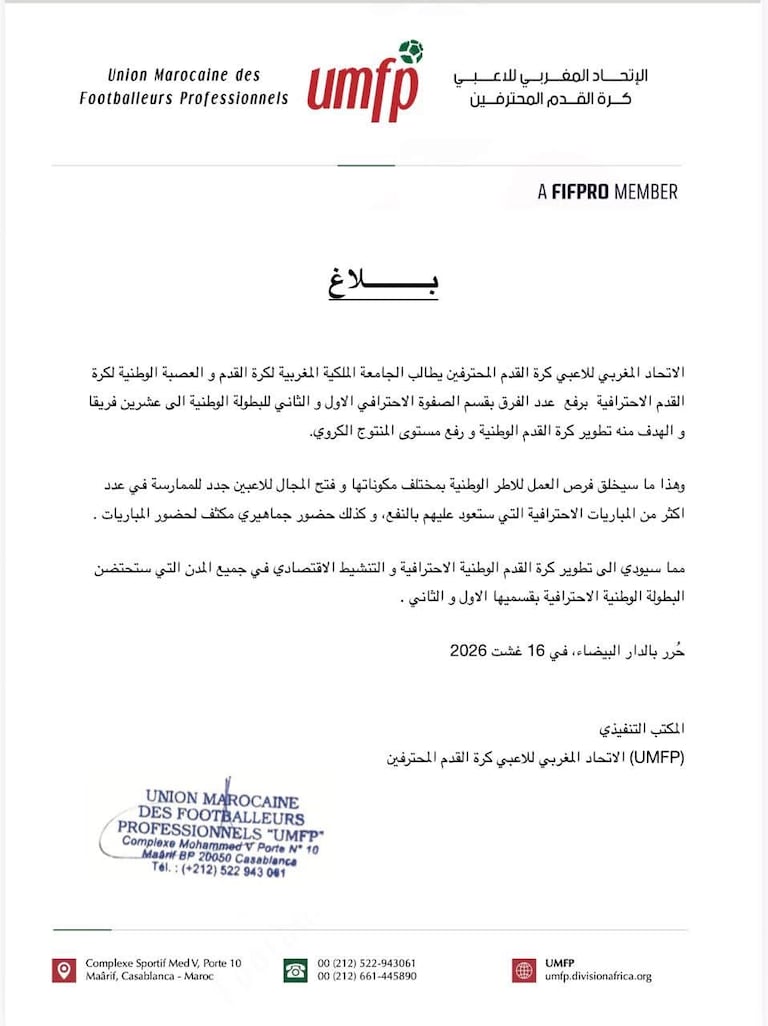
The idea was already championed by several presidents at the end of last season. Coaches subsequently joined them. This Sunday, Aug. 16, it was the turn of the Moroccan Union of Professional Footballers (UMFP) to officially call for the first and second divisions to be expanded to 20 clubs.
In a statement, the organization that represents and defends the interests of professional players called on the Royal Moroccan Football Federation (FRMF) and the National Professional Football League (LNFP) to take the step. The UMFP puts forward several arguments: more jobs for people working in football, more opportunities for players, a greater number of professional matches, larger crowds at stadiums and, more broadly, a positive economic impact on the cities concerned.
On paper, it is difficult to oppose more jobs, matches and economic activity. But football does not develop simply by adding more clubs. And before asking how many clubs the Botola should have, a much more basic question needs to be asked: does the current 16-team league function well enough to accommodate four more?
What problem is this reform supposed to solve?
This determination to expand the Botola remains difficult to understand. What specific problem in Moroccan football is a 20-club league supposed to solve?
Read also : Botola Pro expansion controversy: Mehdi Bensaïd categorically denies any involvement
The LNFP is already struggling to maintain a stable schedule with 16 teams. Season after season, the same complaints return: postponements, rescheduled matches, date changes, a lack of visibility for clubs, broadcasters and supporters, and sometimes an unbearable succession of fixtures for teams competing in African competitions.
And the schedule has to accommodate more than the 30 league matchdays. There is also the Throne Cup, CAF club competitions, FIFA international windows and the various commitments of the national teams.
Under these circumstances, moving from 16 to 20 clubs would increase the league from 30 to 38 matchdays. That means eight additional dates for each team. Across the competition, that amounts to 64 more matches to schedule, referee, organize and secure. So the question is simple: where would they fit?
When the system is already struggling to fit the existing program into a season, adding 64 matches looks less like structural reform than a headlong rush forward.
More clubs, but with what money?
The other blind spot in the proposal is financial. A significant number of Moroccan professional clubs are already in a precarious position. Outstanding debts, unpaid salaries, disputes with former players or coaches and transfer bans regularly make the headlines.
Moving to 38 matchdays does not simply mean playing more games. It means more travel, bonuses, accommodation, organizational and security costs. To cope with a longer and more demanding season, clubs would also need sufficiently deep squads. That means signing more players and paying more salaries.
Creating jobs is obviously desirable. But those jobs have to be funded. What is the point of offering more contracts if some employers are already struggling to honor the ones they sign today? Without a substantial and sustained increase in revenue, expansion risks primarily multiplying costs and, eventually, disputes.
Broadcasting rights, ticket sales, sponsorship and marketing would normally form the economic foundation of such a reform. But there is currently nothing to show that league revenues would automatically increase simply because four additional clubs were taking part. More matches do not automatically mean a better product.
Stadiums under construction and 64 additional matches
Another very practical problem must also be factored in: infrastructure. Morocco is engaged in a major program to build and renovate stadiums ahead of the 2030 World Cup. Several major venues are either undergoing or will undergo work, creating constraints for clubs that sometimes have to find alternative venues.
Playing away from home supporters or in a neutral venue is never without consequences. It means lower ticket revenue, sometimes more travel and a weakened relationship with supporters.
It is precisely during this period of heavy pressure on infrastructure that the proposal would add 64 matches to the professional calendar. The contradiction is hard to ignore.
And what would it achieve on the sporting front?
Then comes the most important issue: what happens on the field? The argument that more clubs and more matches would automatically raise players’ level also deserves scrutiny. Quantity does not necessarily produce quality.
Read also : A 20-team Botola? Not so fast
Moroccan football is already living through a striking paradox. The Atlas Lions have gradually established themselves among the leading teams in African football and have gained a new international stature. But this success is largely built on players developed abroad, many of them from the diaspora, along with talents produced by the Mohammed VI Football Academy.
Meanwhile, players competing in the Botola struggle to secure a lasting place in the senior national team.
Perhaps this is a more important question than the number of participants: why does a professional league that is supposed to represent the top of the national football pyramid produce so few players capable of establishing themselves with the Atlas Lions?
Expanding the Botola to 20 clubs does not answer that question. It could even dilute the overall level if expansion is not preceded by work on player development, governance, club resources, infrastructure and the sporting standards imposed on top-flight clubs.
Why now?
The timing of this campaign for a 20-club Botola also raises questions. The LNFP has invited the presidents of first- and second-division clubs to a meeting scheduled for Monday, Aug. 17. According to our information, increasing the number of teams to 20 in Botola 1 and Botola 2, starting this season, is among the issues to be discussed.
If this reform is genuinely supposed to take effect immediately, it deserves much more than a summer meeting and a succession of statements.
Such a sweeping transformation should be accompanied by an economic study, a projected schedule, an assessment of available infrastructure, projections for broadcasting rights, a financial mechanism for clubs and, above all, a long-term vision.
Another question then arises: would the 20 clubs be here to stay? Or would this be an exceptional format before a possible return to 16 teams a few seasons later? Moroccan football has already seen innovations presented as structural reforms before being abandoned or significantly overhauled, with the Excellence Cup being the most recent example.
Changing the format of a professional league cannot become a variable to be adjusted depending on circumstances.
Is this really the priority?
The Botola needs reform. No one can seriously dispute that. It needs a clear and respected schedule. Financially sound clubs. Effective youth academies. Available stadiums. A more attractive broadcasting product. Better commercialization. Governance capable of giving clubs, sponsors and supporters greater visibility. And, above all, a league competitive enough to supply more players to the national team.
Once those foundations have been consolidated, the debate over the ideal number of clubs can certainly be opened. It may even turn out that a league with 18 or 20 teams is the right model.
But starting with the number of clubs while so many structural problems remain unresolved means treating the symptom before establishing the diagnosis.
The Botola still needs solid foundations. Yet the ring is already on offer.