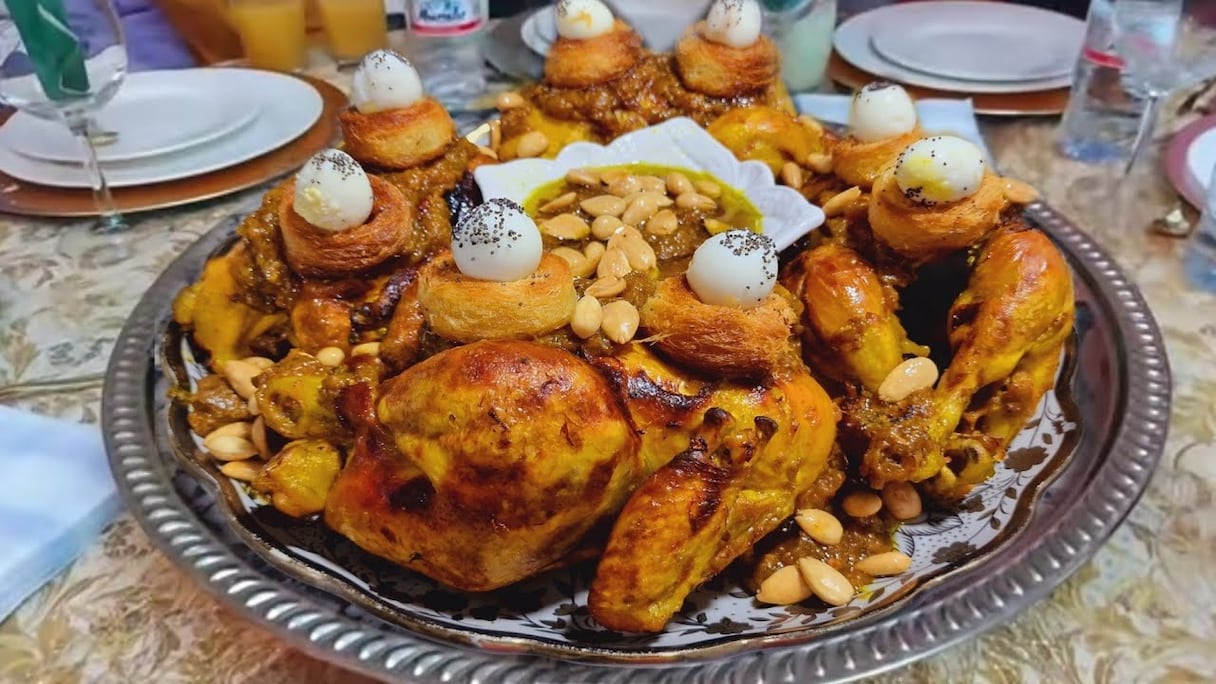
Chicken has shot from MAD 17 to as much as MAD 24 a kilogram in several cities in the middle of the election campaign, and some of the blame has inevitably landed at the doors of campaign kitchens.
Retailers in Casablanca told Le360 of unusually large orders from what they called “election shops,” where chicken is being booked for collective meals in working-class neighborhoods.
The sight of 196 large dishes of Madhoussa, each covered with chicken, at a gathering in El Houafate in the Gharb only gave the argument more meat.
The banquet, attributed to Popular Movement MP Abdelnabi El Aidoudi, drew hundreds of citizens and supporters and quickly travelled beyond Sidi Kacem on social media.
Critics called it “belly democracy,” accusing candidates of courting voters with full plates rather than programs. El Aidoudi’s supporters denied the meal was intended to influence voters, arguing that feeding tribal delegations and visitors was part of the region’s rural tradition.
At chicken shops, however, MAD 24/kg remains MAD 24/kg—and poultry producers insist 196 dishes, or even a campaign’s worth of them, do not explain it.
Mustapha Montasser, president of the National Association of Poultry Meat Producers (APVE), said weekly chick production had fallen by about 40pc, from 12.5 million to around 7.5m.
Mohamed Abboud, president of the National Association of Broiler Chicken Farmers, made much the same point from the wholesale end. According to him, fewer trucks carrying poultry have been arriving at Casablanca’s market than during the summer.
For Montasser, today’s shortage began before Eid Al Adha.
Production had run well ahead of demand, birds piled up on farms and farm-gate prices sank to MAD 6-8/kg. Farmers took the losses and many left their poultry houses empty during May and June.
Chicks themselves had fallen to around 30 centimes, pushing hatcheries to dispose of breeding hens early.
By September, the surplus was gone. So were millions of chicks that would otherwise have been reaching the market.
That does not mean the poultry trade agrees on who is responsible.
Abboud accused major hatchery operators of deliberately cutting production to manufacture a shortage and drive prices higher, benefiting large operators at the expense of small farmers.
Montasser instead sees the familiar problem of a market swinging from too much chicken to too little. He wants industrial slaughterhouses and cold-storage units to take poultry off the market when farms are producing too much, freeze it and put it back into circulation when supplies run short.
For households waiting for cheaper chicken, election day (Sept 23) may come first.
Montasser expects tight supplies and high prices to last through September and the first half of October. He sees prices moving back towards MAD 12-14/kg from late October and through November and December.
A broiler production cycle takes more than 70 days from hatching through feeding and fattening. The empty poultry houses of May and June cannot be filled retrospectively.